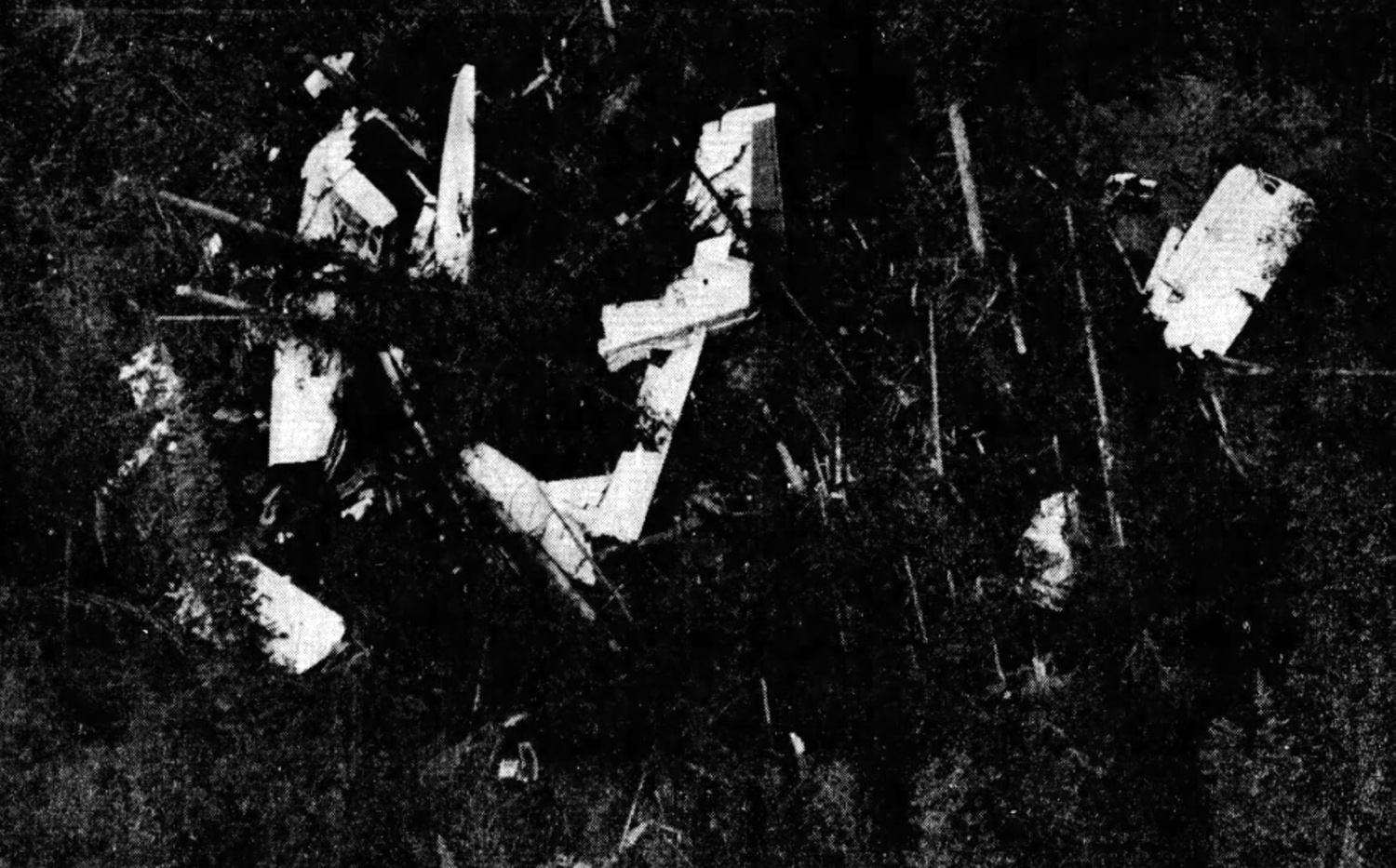
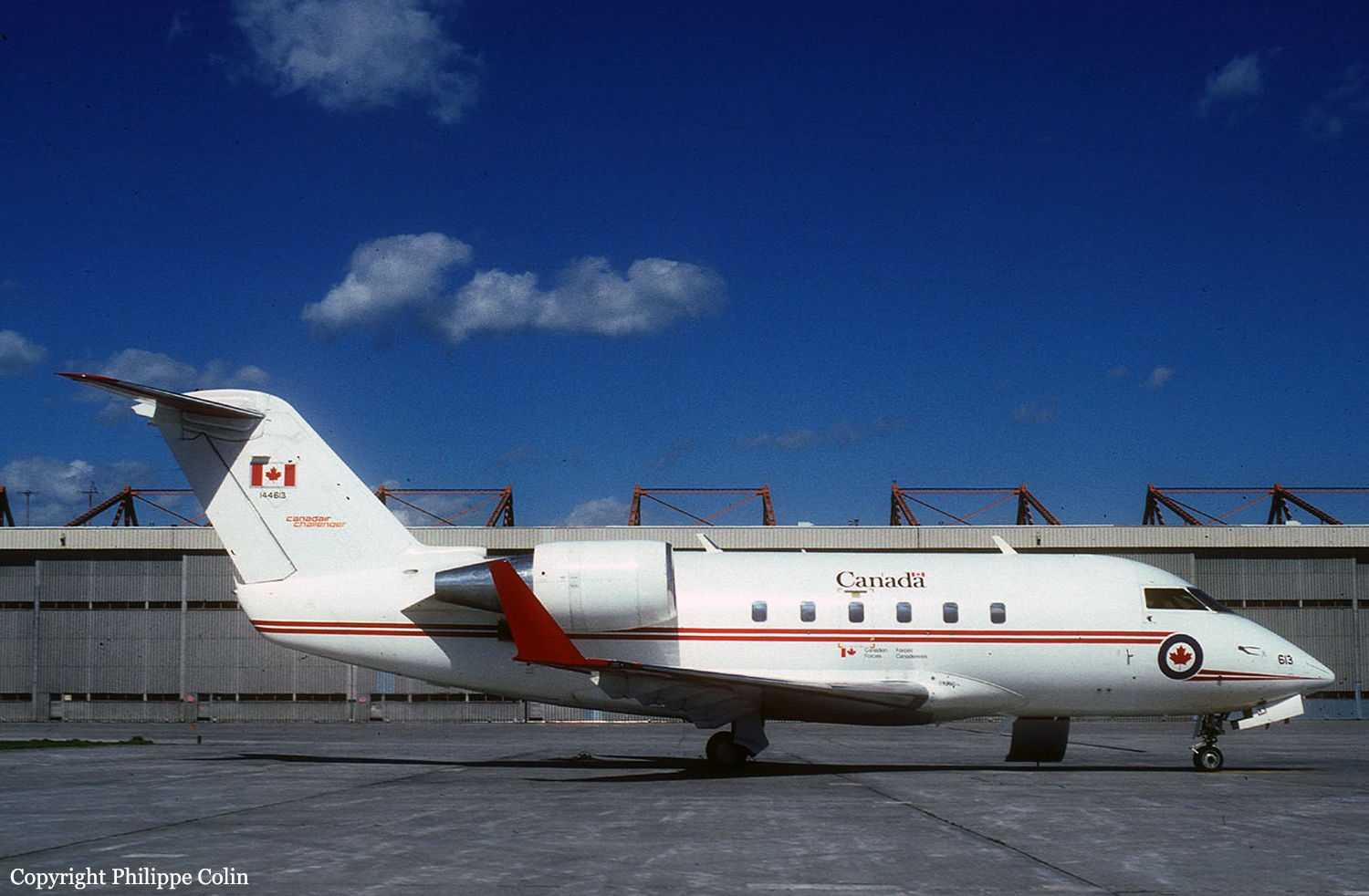
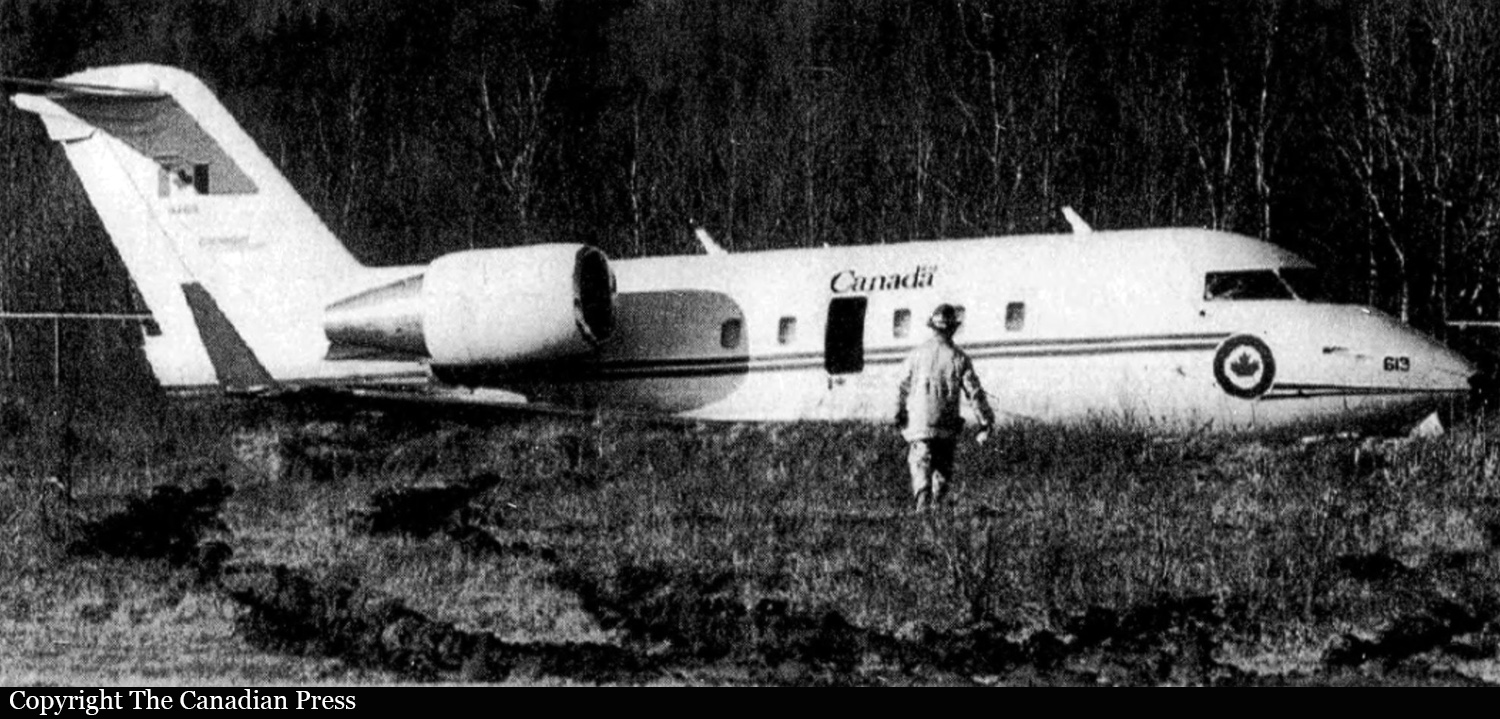
Crash of a Canadair CC-144A Challenger 601 in Shearwater

Date & Time: Apr 24, 1995
Type of aircraft:
Operator:
Registration:
144613
Flight Type:
Survivors:
Yes
Schedule:
Shearwater - Shearwater
MSN:
3035
YOM:
1984
Country:
Crew on board:
4
Crew fatalities:
Pax on board:
0
Pax fatalities:
Other fatalities:
Total fatalities:
0
Circumstances:
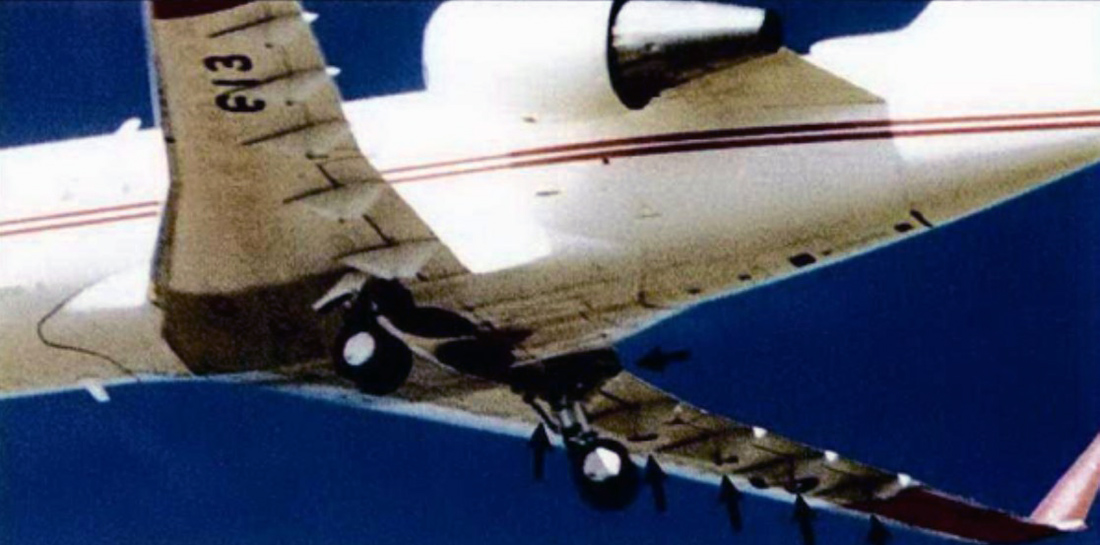
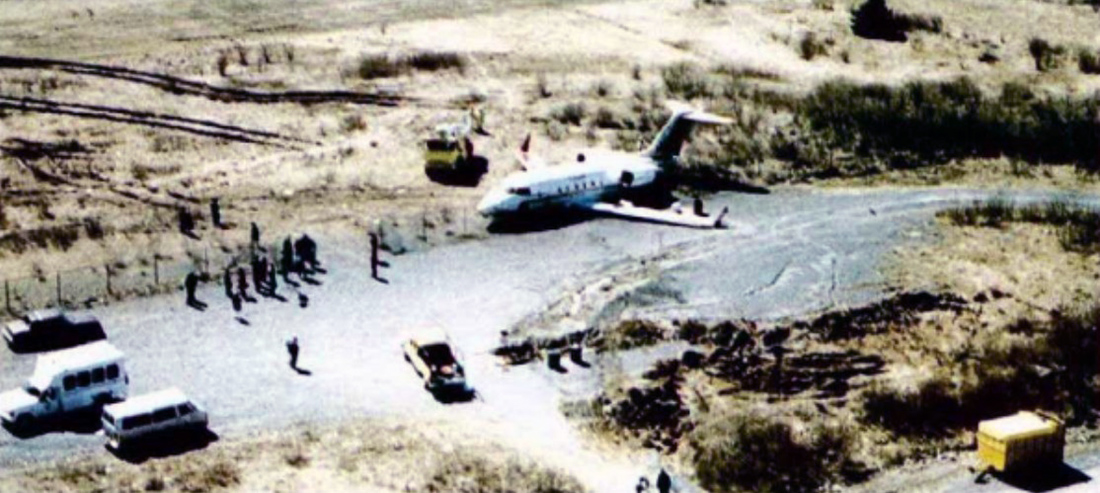
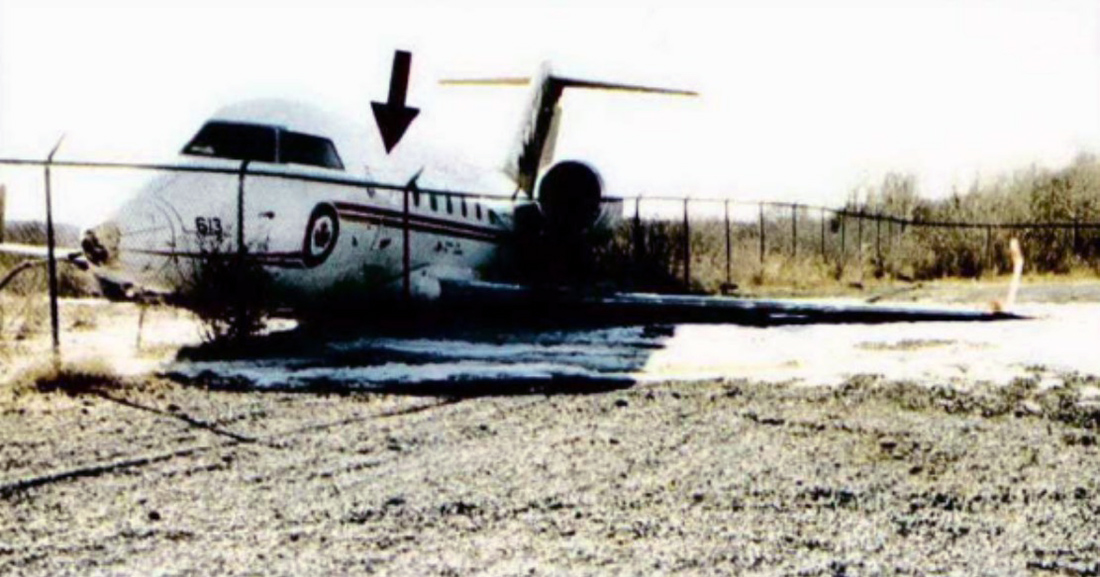
The crew (one instructor and three pilots under training) departed Shearwater Airport on a local training mission. The crew decided to perform a flapless landing but the aircraft arrived too high and to correct the situation, the pilot-in-command nosed down when the aircraft landed very hard and bounced. The crew initiated a go-around procedure and decided to follow a holding pattern after being informed by ATC based in the tower that the right main gear seems to be damaged. About 40 minutes later, the right main gear fell away. The right engine then lost power and a fire erupted in the right wheel well. The crew declared an emergency and was cleared to return to Shearwater Airport. Upon landing, the aircraft sank on its right side then rolled for few dozen metres before coming to rest, bursting into flames. All four occupants escaped uninjured before an explosion occurred in the central fuel tank.
Probable cause:
It was determined that during the first hard landing, the right main gear was seriously damaged upon impact as well as hydraulic and fuel line.
Crash of a Grumman CS-2F-3 Tracker in Bayswater: 2 killed

Date & Time: Oct 5, 1976
Type of aircraft:
Operator:
Registration:
12182
Flight Phase:
Flight Type:
Survivors:
No
Schedule:
Shearwater - Shearwater
MSN:
DH81
YOM:
1960
Country:
Crew on board:
2
Crew fatalities:
Pax on board:
0
Pax fatalities:
Other fatalities:
Total fatalities:
2
Circumstances:
Crashed in unknown circumstances in Bayswater while completing a local training mission out from Shearwater AFB. Both occupants were killed.

Crash of a De Havilland DHC-6 Twin Otter 100 near Mosher Creek: 1 killed

Date & Time: Sep 22, 1976 at 1110 LT
Operator:
Registration:
CF-AWF
Flight Phase:
Survivors:
Yes
Site:
Schedule:
Campbell River – Shearwater – Bella Coola – Vancouver
MSN:
67
YOM:
1967
Country:
Crew on board:
2
Crew fatalities:
Pax on board:
16
Pax fatalities:
Other fatalities:
Total fatalities:
1
Captain / Total flying hours:
4300
Captain / Total hours on type:
2500.00
Circumstances:
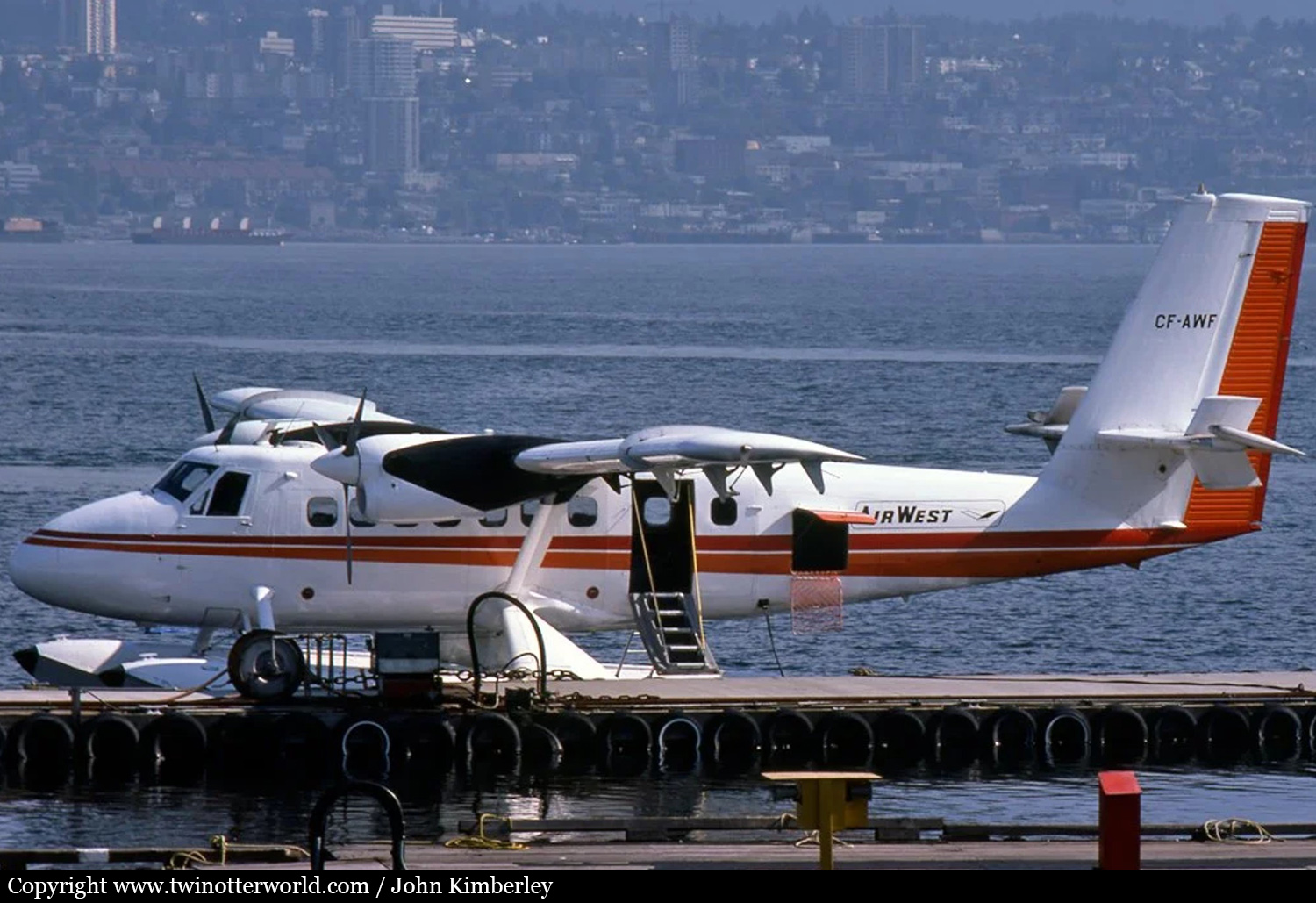
The aircraft had been chartered to carry a group of Canadian and American fishery engineers on a tour of fishery installations and projects in British Colombia. Two similar aircraft were used, each carrying 16 passengers. The proposed flight was to go from Campbell River to various points and then back to Vancouver the same day. After refueling at Shearwater, the aircraft was flown at a low altitude and through marginal weather conditions to the Atnarko River counting station. There the pilot, on request of the tour director, circled the aircraft within the confines of a narrow valley at an altitude of approximately 500 feet above the terrain. After the third orbit of the area, he initiated a climb in a northeasterly direction along the northern slope, paralleling the contours of the valley. On reaching an altitude of approximately 3,000 feet, he turned further to the left to follow a creek while continuing his climb directly toward a ridge located at the 6,000 feet elevation. At approximately 4,300 feet, the pilot realized the aircraft could not outclimb the gradient of the terrain. He attempted to turn to the left to reverse his course. As he banked the aircraft, it began to shudder as though it was entering a stall. He leveled the wings and at almost the same instant the undercarriage began striking trees. The aircraft struck the tree-covered slope with the undercarriage absorbing the majority of the impact forces. During the impact, the tail section aft of the cabin area and the right wing separated from the fuselage. The remainder of the fuselage came to rest in a comparatively level attitude allowing the crew and passengers to evacuate the wreckage. One passenger succumbed to his injuries approximately four hours after the impact, the others survived. There was no survival gear and no emergency signalling equipment on the aircraft. The copilot placed the ELT (Emergency Locator Transmitter) on the top of the wreckage and activated it manually; it failed to operate due to impact damage.
Probable cause:
It is concluded that the pilot, while climbing along the contours of a steep side hill to clear a high ridge, misjudged the height and the gradient of the terrain. He also did not cater for the reduced climb performance of the aircraft resulting from the overweight condition. On realizing his predicament, he attempted to turn away from his intended flight path. His airspeed had decreased to a point where, as he attempted the bank to the left, the aircraft entered a stall.
The following findings were identified:
- The aircraft was overloaded. Evidence indicates that the aircraft was between 1'000 and 1'600 pounds overloaded on departure from Shearwater. Allowing one hour fuel burn-off from Shearwater to the accident site, the aircraft would have exceeded the maximum authorized gross weight by between 400 - 1'000 pounds at the time of impact.
- The pilot misjudged the climb capability of the overloaded aircraft relative to the climb gradient required for terrain clearance.
- The Company did not provide adequate emergency survival equipment on the aircraft.
Final Report:

Crash of a Grumman CS-2F-3 Tracker off Sheet Harbour: 4 killed

Date & Time: Apr 19, 1971
Type of aircraft:
Operator:
Registration:
12175
Flight Phase:
Survivors:
No
Schedule:
Shearwater - Shearwater
MSN:
DH74
YOM:
1960
Country:
Crew on board:
4
Crew fatalities:
Pax on board:
0
Pax fatalities:
Other fatalities:
Total fatalities:
4
Circumstances:
Crashed in unknown circumstances into the sea off Sheet Harbour while on a maritime patrol flight out from Shearwater AFB. All four crew members were killed.

Crash of a Consolidated PB2B-1 Canso A near Shearwater: 1 killed

Date & Time: Jul 30, 1943 at 0557 LT
Type of aircraft:
Operator:
Registration:
9789
Flight Phase:
Flight Type:
Survivors:
Yes
Schedule:
Shearwater - Shearwater
MSN:
22018
YOM:
1943
Country:
Crew on board:
8
Crew fatalities:
Pax on board:
0
Pax fatalities:
Other fatalities:
Total fatalities:
1
Captain / Total flying hours:
1065
Captain / Total hours on type:
84.00
Copilot / Total flying hours:
536
Copilot / Total hours on type:
241
Circumstances:
The crew was briefing at 0500 hrs, started engines at 0540 and started the takeoff run at 0552. The aircraft take off weight was 33,426 lbs which was near the maximum allowable takeoff weight of 34,500. The aircraft became airborne after an abnormally long run and circled the area while climbing to 700’. As the direct route to the patrol area, Seaforth Channel, was closed by weather PO Joseph headed south via the west side of Lama Passage. The ceiling lowered so he descended to stay under the cloud. Suddenly the fog closed in and Joseph turned the aircraft to the left attempting to return to Base on a reciprocal course. His airspeed was 120 knots but altitude could not be maintained in the 35 degree turn like he used to do in a Stranraer. The aircraft was leveled off after turning through 120 degrees as they were getting close to the water. The aircraft was put into a steep climbing position at full power. They had started climbing in the patchy fog when the pilot saw a wooded ridge. They increased the rate of climb and the speed dropped to 70 knots and was down to 50 knots by the time they mushed into the 700’ mark on an 800’ ridge. On impact the a/c caught fire. They had been airborne a total of five minutes.
Crew:
P/O J. A. Joseph, pilot,
F/Sgt K. L. Brown, copilot,
P/O J. L. Jones, navigator,
F/O R. B. Shirra, wireless operator and air gunner,
Sgt H. A. S. Rawlinson, wireless operator and air gunner,
Sgt E. A. Kershsaw,
Sgt J. A. Cowman, flight engineer, †
LAC W. J. Johnston, flight engineer.
Source: http://www.101nisquadron.org/?page_id=1539
Probable cause:
The cause of the crash was assessed as pilot error because of an inability through the lack of experience on the type of aircraft, the pilot was unable to control the aircraft during the turn and was obliged to straighten out. He then realized the presence of hills ahead and attempted to clear them by climbing but was unable to. It would have been advisable to have landed straight ahead when he encountered the fog or to have climbed to 2,000’ and then proceeded to sea rather than attempting a turn at low altitude in a narrow channel with a heavily laden aircraft.

Crash of a Lockheed L-414 Hudson I in Shearwater

Date & Time: Oct 3, 1941 at 0605 LT
Type of aircraft:
Operator:
Registration:
773
Flight Phase:
Flight Type:
Survivors:
Yes
Schedule:
Shearwater - Shearwater
MSN:
414-1772
YOM:
1940
Country:
Crew on board:
4
Crew fatalities:
Pax on board:
0
Pax fatalities:
Other fatalities:
Total fatalities:
0
Captain / Total flying hours:
311
Copilot / Total flying hours:
56
Circumstances:
When the tail came up on takeoff, the starboard wing went down. 200 yards short of the end of the runway, the pilot closed the throttles and uses brake. At this time, the aircraft was travelling at a speed of 60-70 knots. The aircraft hit a ditch with its port wing that was crumpled and came to rest, bursting into flames. The fire extinguisher was used with no effect. All four crew members evacuated safely, among them two were slightly injured. The aircraft blew up.
Crew:
Sgt D. F. Quirt, pilot,
Sgt D. E. McInnis, navigator,
LAC G. C. Merrill, wireless operator,
Sgt H. F. Taylor, air gunner.
Final Report: