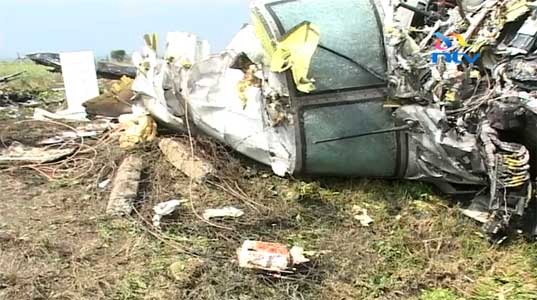
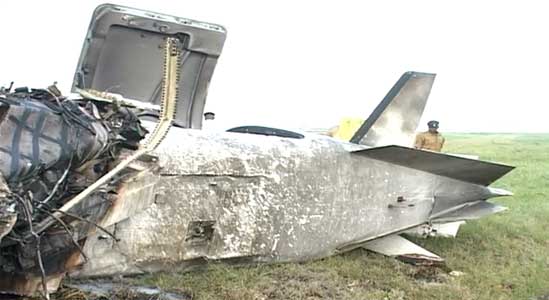
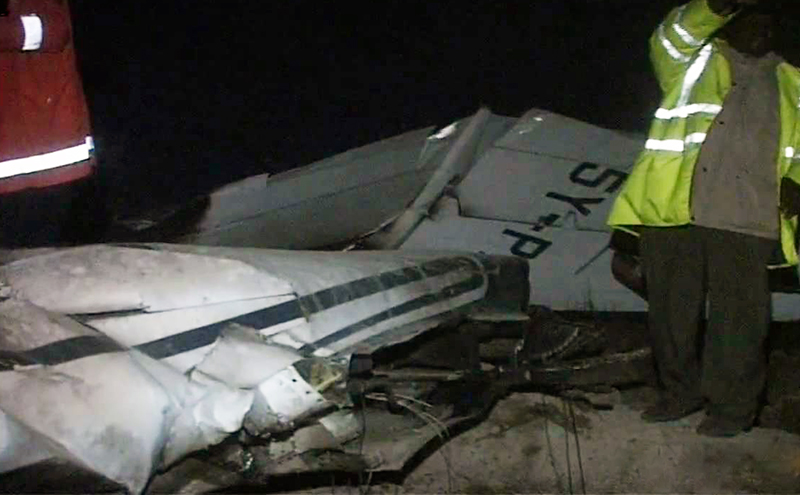
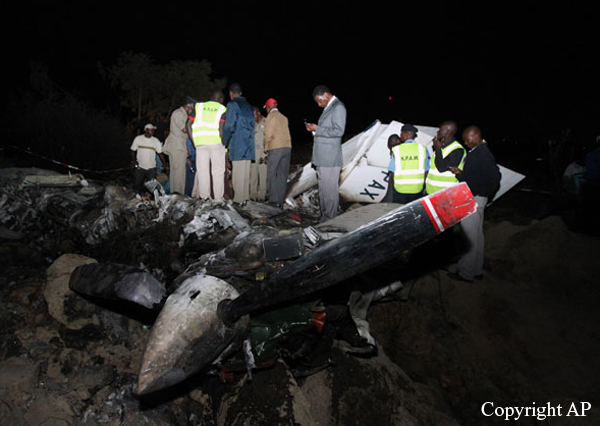
Crash of a Beechcraft 1900D in Nairobi: 2 killed

Date & Time: Nov 9, 2009 at 0517 LT
Type of aircraft:
Operator:
Registration:
5Y-VVQ
Flight Type:
Survivors:
No
Schedule:
Nairobi – Guriceel
MSN:
UE-250
YOM:
1996
Country:
Region:
Crew on board:
2
Crew fatalities:
Pax on board:
0
Pax fatalities:
Other fatalities:
Total fatalities:
2
Aircraft flight hours:
15866
Aircraft flight cycles:
15941
Circumstances:
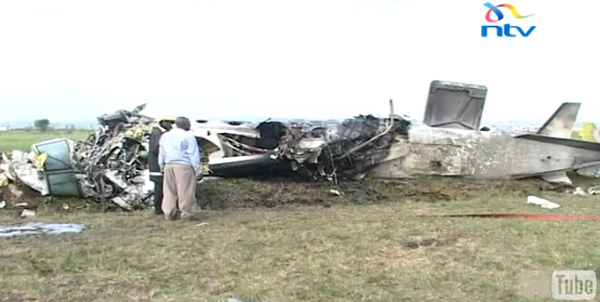
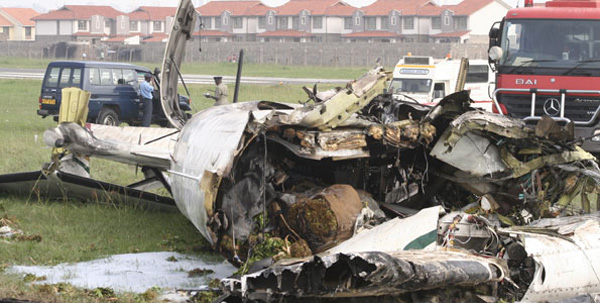
The airplane departed Wilson Airport at 03:39 hours, transporting a cargo of miraa to Guriceel Airstrip, Somalia. Taxi, take off and climb were uneventful. However, at 04:23 and flying at FL230 the crew contacted Nairobi Area Control Centre (ACC) and requested for a turn back to Wilson Airport due to a 'slight problem'. At about the same time, the aircraft made a right turn from a heading of 50° to 240° magnetic and commenced descent. The crew reported descending to FL220 and expressed intention to descend further to FL180. However, ACC informed the crew to initially maintain FL200 due to traffic moving in the opposite direction. At 04:28 the crew informed ACC that they were unable to maintain FL200 and requested to descend to FL180 having crossed the opposite traffic. At 04:29, the crew confirmed to Air Traffic Control (ATC) that they were heading to Wilson Airport and indicated that they did not require any assistance. The aircraft continued descending until FL120. The Nairobi Approach Radar established contact with the aircraft at 04:41 and indicated to the crew that they were 98 nautical miles North East of November Victor. The crew was then told to turn left to a heading of 225° and report when they were top of descent, which they did. The crew reported again that they had a 'slight problem' and as a safety measure they had to shut down one engine. They also expressed desire to route direct to Silos. At 04:42 5Y-VVQ aligned with the North East access lane via Ndula Marker. At 04:45, the crew confirmed to Nairobi Approach Radar that the malfunction was on the left engine and again acknowledged that they did not require any assistance. At 04:51, the crew requested for radar vectors for an ILS approach to runway 06 at Jomo Kenyatta International Airport with a long final to runway 32 of Wilson Airport. At 05:09, the aircraft descended to 8000ft heading 260°. At 05:14, the crew was given vectors for runway 32 Wilson Airport. At the same time, the aircraft turned right to a heading 310° as it continued to descend to 7000ft. The crew confirmed the vectors and at 05:15 stated that they were passing Visual Meteorological Conditions (VMC). They were also informed that the Wilson Airport runway 32 was 6.5 nautical miles away in the two o'clock direction. The aircraft continued to descend to 6000ft and at 05:16, the crew confirmed sight of runway 32. The crew was then transferred from the radar to the Wilson Tower frequency for landing. 5Y-VVQ was cleared for a straight-in approach to runway 32. Wilson Tower then communicated to the crew airfield QNH was 1022hPa and that winds were calm. The Tower controller had 5Y-VVQ visual and it was cleared to land on runway 32. At about the same time, the aircraft made a 5° right bank and again leveled off before making a steep left bank rising to 30° within 4 seconds. According to Tower and eyewitness information, the aircraft appeared high on approach and on short-final, it was observed to turn a bit to the right. This was followed by a steep left bank. The aircraft left wing hit the ground first approximately 100 meters outside the airport perimeter fence. The aircraft then flipped over, hitting and breaking the airport fence and coming to rest on the left of runway 32 approximately 100 meters from its threshold. The aircraft immediately caught fire upon the impact. Upon further investigations and interview of company personnel, it was established that the crew had made the decision to shut down the left engine following a low oil pressure warning. The flight crew did not declare an emergency.
Probable cause:
The investigation determined the probable cause of the accident as loss of aircraft control at low altitude occasioned by operation of the aircraft below VMCA during one engine inoperative approach.
Other significant contributory factors to this accident include:
- Inadequate pilot training on single engine operation and VMCA;
- inappropriate handling technique during one engine inoperative flight;
- inability of the pilot to monitor the degrading airspeed.
Crash of a Cessna 404 Titan in Nairobi: 1 killed

Date & Time: Sep 14, 2009 at 1920 LT
Type of aircraft:
Operator:
Registration:
5Y-PAX
Flight Phase:
Flight Type:
Survivors:
Yes
Schedule:
Nairobi - Nairobi
MSN:
404-0104
YOM:
1977
Country:
Region:
Crew on board:
2
Crew fatalities:
Pax on board:
0
Pax fatalities:
Other fatalities:
Total fatalities:
1
Circumstances:
The crew was completing a local training at Nairobi-Wilson Airport. Shortly after takeoff, while in initial climb, the twin engine aircraft stalled and crashed, bursting into flames. One pilot was killed while the second one was seriously injured. The aircraft was destroyed.

Crash of a Cessna 208B Grand Caravan in Doro

Date & Time: Apr 28, 2008 at 1240 LT
Type of aircraft:
Operator:
Registration:
5Y-SPK
Flight Phase:
Flight Type:
Survivors:
Yes
Schedule:
Doro - Nairobi
MSN:
208B-0243
YOM:
1990
Country:
Region:
Crew on board:
1
Crew fatalities:
Pax on board:
4
Pax fatalities:
Other fatalities:
Total fatalities:
0
Circumstances:
The single aircraft was on a return flight from Doro to Nairobi, carrying four mission personnel who took part to a humanitarian mission in the region of Doro. The takeoff was performed from a muddy airstrip and the aircraft was unable to gain sufficient height after liftoff. As a result, the left wing impacted a tree trunk and the airplane crashed in a ditch, coming to rest upside down. All five occupants escaped uninjured.

Crash of a Beechcraft B200 Super King Air in Garissa

Date & Time: Aug 6, 2007
Operator:
Registration:
5Y-HHM
Flight Type:
Survivors:
Yes
Schedule:
Nairobi - Garissa
MSN:
BB-1152
YOM:
1983
Country:
Region:
Crew on board:
2
Crew fatalities:
Pax on board:
0
Pax fatalities:
Other fatalities:
Total fatalities:
0
Circumstances:
The crew was completing a positioning flight from Nairobi to Garissa. On final approach to Garissa, a donkey entered the runway. The crew initiated a go-around procedure but the aircraft stalled and landed very hard. Both pilots escaped uninjured while the aircraft was damaged beyond repair.

Crash of a Let L-410UVP-E3 near Mwingi: 2 killed

Date & Time: May 23, 2004 at 0730 LT
Type of aircraft:
Operator:
Registration:
5Y-VVD
Flight Phase:
Flight Type:
Survivors:
No
Schedule:
Nairobi - Mogadishu
MSN:
87 20 09
YOM:
1987
Location:
Country:
Region:
Crew on board:
2
Crew fatalities:
Pax on board:
0
Pax fatalities:
Other fatalities:
Total fatalities:
2
Circumstances:
The twin engine aircraft departed Nairobi-Wilson Airport on a cargo flight to Mogadishu, carrying two pilots and a load of 1,500 kilos of khat. About an hour into the flight, while in cruising altitude, the aircraft collided with a second Let L-410UVP also operated by Bluebird Aviation and registered 5Y-VVA. While the crew of 5Y-VVA was able to complete an emergency landing and the aircraft suffered small damages, 5Y-VVD entered an uncontrolled descent and crashed 30 km south of Mwingi, killing both pilots.

Crash of a Fokker F28 Fellowship 4000 in Lokichoggio

Date & Time: Dec 7, 2003 at 1337 LT
Type of aircraft:
Operator:
Registration:
5Y-NNN
Survivors:
Yes
Schedule:
Nairobi – Lokichogio
MSN:
11231
YOM:
1986
Flight number:
HSA812
Country:
Region:
Crew on board:
4
Crew fatalities:
Pax on board:
23
Pax fatalities:
Other fatalities:
Total fatalities:
0
Circumstances:
After touchdown at Lokichogio Airport, the crew started the braking procedure when the tyre n°1 on the nose gear burst. Unable to stop within the remaining distance, the airplane overran, collided with a fence and came to rest in a ditch with its nose gear torn off. All 27 occupants evacuated safely while the aircraft was damaged beyond repair.

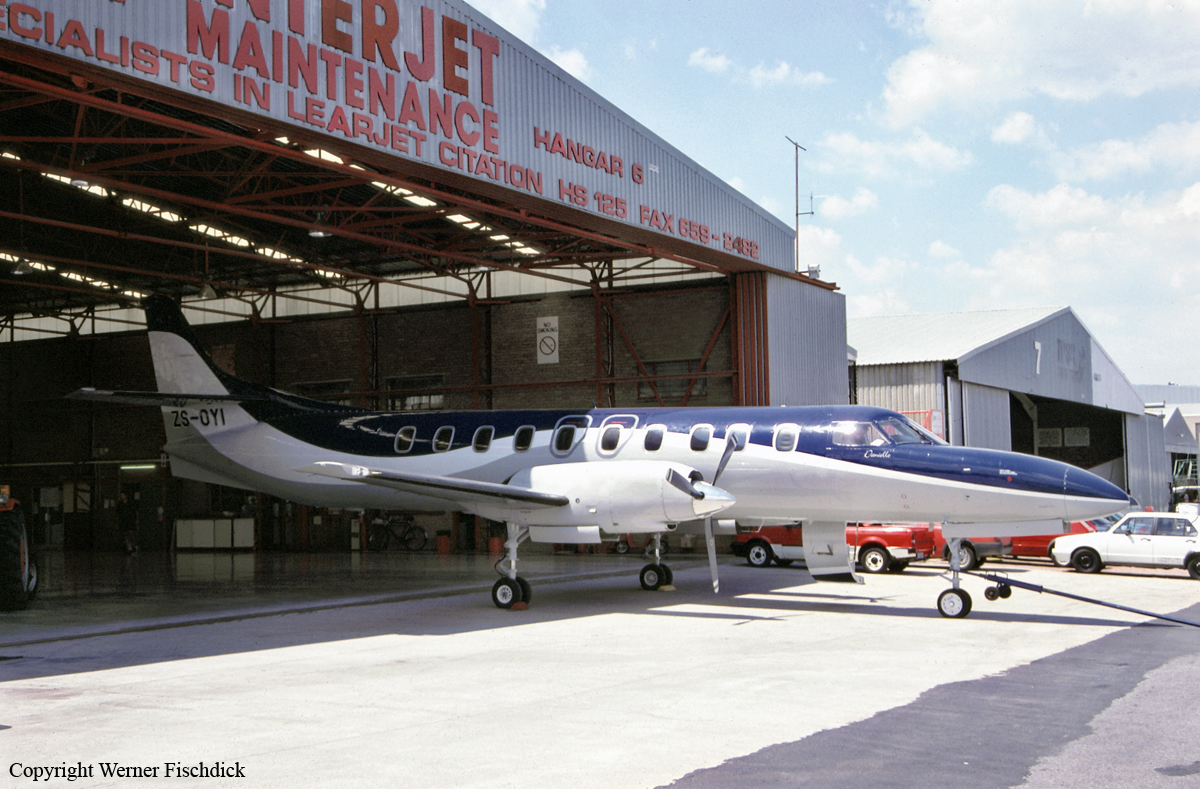
Crash of a Swearingen SA226TC Metro II on Point Lenana: 14 killed

Date & Time: Jul 19, 2003 at 1800 LT
Type of aircraft:
Registration:
ZS-OYI
Flight Phase:
Survivors:
No
Site:
Schedule:
Nairobi – Samburu
MSN:
TC-349
YOM:
1980
Country:
Region:
Crew on board:
2
Crew fatalities:
Pax on board:
12
Pax fatalities:
Other fatalities:
Total fatalities:
14
Circumstances:
The twin engine aircraft departed Nairobi-Wilson Airport at 1558LT on a charter flight to Samburu, carrying 12 passengers (all US citizens) and two pilots. En route, the crew decided to make a tour over the Mt Kenya before continuing to Samburu. While cruising at an altitude of 16,500 feet in clouds, the aircraft struck the eastern slope of Mt Point Lenana (third highest peak of Mt Kenya). The wreckage was found 450 feet below the summit and all 14 occupants were killed.
Probable cause:
Controlled flight into terrain after the crew failed to maintain horizontal and vertical situational awareness of the aircraft’s proximity to the surrounding terrain.
The following contributing factors were identified:
- Unfamiliarity with the airspace and the route in particular and the existence of high ground on the planned flight route,
- Inadequate flight planning by the pilots and distraction of their attention when they were instructed to contact Nanyuki,
- Poor pilot briefing by the Wilson ATC briefing office,
- Poor communication between the air traffic control units,
- Failure of the radar controller to advise the pilot of termination of radar service,
- Lack of a radar system minimum safe altitude warning to the radar controller,
- Poor civil military coordination during transit through the military airspace.

Crash of a Cessna 208 Caravan I in Nairobi

Date & Time: Jul 12, 2000
Type of aircraft:
Operator:
Registration:
5Y-JAO
Flight Phase:
Survivors:
Yes
MSN:
208-0202
YOM:
1991
Country:
Region:
Crew on board:
0
Crew fatalities:
Pax on board:
0
Pax fatalities:
Other fatalities:
Total fatalities:
0
Circumstances:
At liftoff, the engine failed. The aircraft stalled and crashed along the runway. There were no casualties but the aircraft was damaged beyond repair.
Probable cause:
Engine failure at takeoff for unknown reasons.

Crash of a Grumman G-159 Gulfstream GI in Mogadishu

Date & Time: Feb 19, 1998 at 1200 LT
Type of aircraft:
Operator:
Registration:
5Y-BMR
Survivors:
Yes
Schedule:
Nairobi - Mogadishu
MSN:
081
YOM:
1961
Country:
Region:
Crew on board:
3
Crew fatalities:
Pax on board:
20
Pax fatalities:
Other fatalities:
Total fatalities:
0
Circumstances:
After landing at Mogadishu Airport, the propeller on the right engine went into fine pitch. The crew lost control of the airplane that veered off runway to the right. While contacting soft ground, the aircraft lost its undercarriage and its tail before coming to rest, broken in two. All 23 occupants evacuated safely and the aircraft was damaged beyond repair.

Crash of a Piper PA-31-350 Navajo Chieftain on Mt Kilimandjaro: 1 killed

Date & Time: Nov 1, 1997 at 1020 LT
Operator:
Registration:
5H-AZM
Flight Phase:
Flight Type:
Survivors:
No
Site:
Schedule:
Nairobi - Zanzibar
MSN:
31-8052207
YOM:
1980
Country:
Region:
Crew on board:
1
Crew fatalities:
Pax on board:
0
Pax fatalities:
Other fatalities:
Total fatalities:
1
Captain / Total flying hours:
10000
Circumstances:
On 1 November 1997 at 09:46 hours 5H-AZM took off from Nairobi Wilson airport, for a visual flight rules flight to Zanzibar International Airport, Tanzania. It was carrying one pilot and some cargo. There were no passengers. The flight plan indicated that the aircraft had 0330 hours of fuel on departure. The pilot planned' to fly a direct route to Zanzibar with Dar-es-salaam International airport as his alternate aerodrome. After take off from Nairobi Wilson, the flight transited the southern axis lane of the Nairobi control Zone to the zone boundary. The pilot checked the Nairobi zone boundary with Nairobi Wilson Tower and was instructed by air traffic control to contact the Nairobi Control Centre. No contact was reported established by Nairobi Control with 5H-AZM. 5H-AZM contacted the Kilimanjaro Control Tower at 10:20 hours and passed his own ward estimates as Flight Information Region 10:25 hours and arrival at Zanzibar at 11:40 hours. 5H-AZM was advised that there was no reported traffic for the flight in the Kilimanjaro Terminal Control area at 'the VFR flight level 115, and at the same time instructed the aircraft to contact Dar-es-salaam Control on 119.6 MHz when in range. No further transmission was received from the aircraft. It also failed to arrive in Zanzibar. Unfruitful formal searches (involving communications, aerial and ground searches) were mounted on 3 November 1997 along the probable route area in Kenya and Tanzania. The formal search was terminated on 4 December 1997 and there after the missing aircraft incident was considered to be an 'accident. Wreckage was eventually located in the Kibo Crater near the summit of Mount Kilimanjaro in Tanzania on 28 August 2003, almost six years later. The wreckage of the Piper PA 31-350 was found at 15,400 feet on the Kibo wing. It was also 30 nautical miles west of its projected track. The aircraft had earlier been cleared to climb from 9,500 feet to 11,500 feet under visual flight rules.
Probable cause:
Controlled flight into terrain for unknown reasons.