Country
Operator Image

Crash of a Cessna 208B Super Cargomaster in Steamboat Springs: 1 killed
Date & Time:
May 5, 2001 at 0858 LT
Operator:
Registration:
N948FE
Survivors:
No
Schedule:
Casper – Steamboat Springs
MSN:
208B-0052
YOM:
1987
Flight number:
FDX8810
Crew on board:
1
Crew fatalities:
Pax on board:
0
Pax fatalities:
Other fatalities:
Total fatalities:
1
Captain / Total hours on type:
43.00
Aircraft flight hours:
8690
Circumstances:
The pilot obtained a weather briefing, filed an IFR flight plan, and departed on a nonscheduled domestic cargo flight, carrying 270 pounds of freight. The flight proceeded uneventfully until it was established on the VOR/DME-C approach. Radar data indicates that after turning inbound towards the VORTAC from the DME arc, the airplane began its descent from 10,600 feet to the VOR crossing altitude of 9,200 feet. Enlargement of the radar track showed the airplane correcting slightly to the left as it proceeded inbound to the VORTAC at 9,400 feet. Shortly thereafter, aircraft track and altitude deviated 0.75 miles northwest and 9,700 feet, 0.5 miles southeast and 9,600 feet, and 0.5 miles northwest and 9,400 feet before disappearing from radar. Witnesses said the weather at the time of the accident was 600 foot overcast, 1.5 miles visibility in "misting" rain that became "almost slushy on the ground," and a temperature of 36 degrees Fahrenheit. One weather study indicated "an icing potential greater than 50% and visible moisture" in the accident area. Another report said "icing conditions were likely present in the area of the accident." The airplane was equipped and certified for flight into known icing conditions. The wreckage was found in a closely area. There was no evidence of pre-impact airframe, engine, or propeller malfunction/failure. The pilot was properly certificated, but his flight time in aircraft make/model was only 38 hours. He had previously recorded 16 icing encounters, totaling 11.2 hours in actual meteorological conditions. He recorded no ice encounters and only 1.0 hour of simulated (hooded) instrument time in the Cessna 208. Microscopic examination of annunciator light bulbs revealed the GENERATOR OFF light was illuminated. This condition indicates a generator disconnection due to a line surge, tripped circuit breaker, or inadvertent switch operation. The operator's chief pilot agreed, noting that one of the items on the Before Landing Checklist requires the IGNITION SWITCH be placed in the ON position. The START SWITCH is located next to the IGNITION SWITCH. Inadvertently moving the START SWITCH to the ON position would cause the generator to disconnect and the GENERATOR OFF annunciator light to illuminate. He said this would be distracting to the pilot.
Probable cause:
An inadvertent stall during an instrument approach, which resulted in a loss of control. Contributing factors were the pilot's attention being diverted by an abnormal indication, conditions conducive to airframe icing, and the pilot's lack of total experience in the type of operation (icing conditions) in aircraft make/model.
Final Report:
Crash of a Cessna 208B Super Cargomaster in Plattsburgh
Date & Time:
Apr 26, 2001 at 1945 LT
Operator:
Registration:
N974FE
Survivors:
Yes
Schedule:
Plattsburgh – Albany
MSN:
208B-0099
YOM:
1988
Flight number:
FDX7417
Crew on board:
1
Crew fatalities:
Pax on board:
0
Pax fatalities:
Other fatalities:
Total fatalities:
0
Captain / Total hours on type:
137.00
Aircraft flight hours:
5993
Circumstances:
The pilot said the preflight, engine start, run-up, taxi and takeoff were "normal". The pilot said that during the climb after takeoff, approximately 1,000 to 1,500 feet above the ground, the airplane's engine "spooled down, slowly and smoothly, like a loss of torque or the propeller going to feather." The pilot performed a forced landing to a field, where the airplane nosed over, and came to rest inverted. Examination of the engine and propeller revealed that the propeller-reversing lever was installed on the wrong side of the reversing lever guide pin, and that the reversing linkage carbon block was no longer installed, and had departed the airplane. Examination of the airplane's maintenance records revealed that the carbon block was replaced during a 100-hour maintenance inspection, 5 hours prior to the accident. Installation of the reversing lever on the incorrect side of the guide pin resulted in improper seating and premature wear of the carbon block. According to the engine manufacturer, any disconnection in operation of the propeller control linkage will cause the propeller governor beta control valve to extend, and drive the propeller into feather.
Probable cause:
The incorrect installation of the propeller reversing lever and carbon block assembly, which resulted in a loss of propeller thrust.
Final Report:
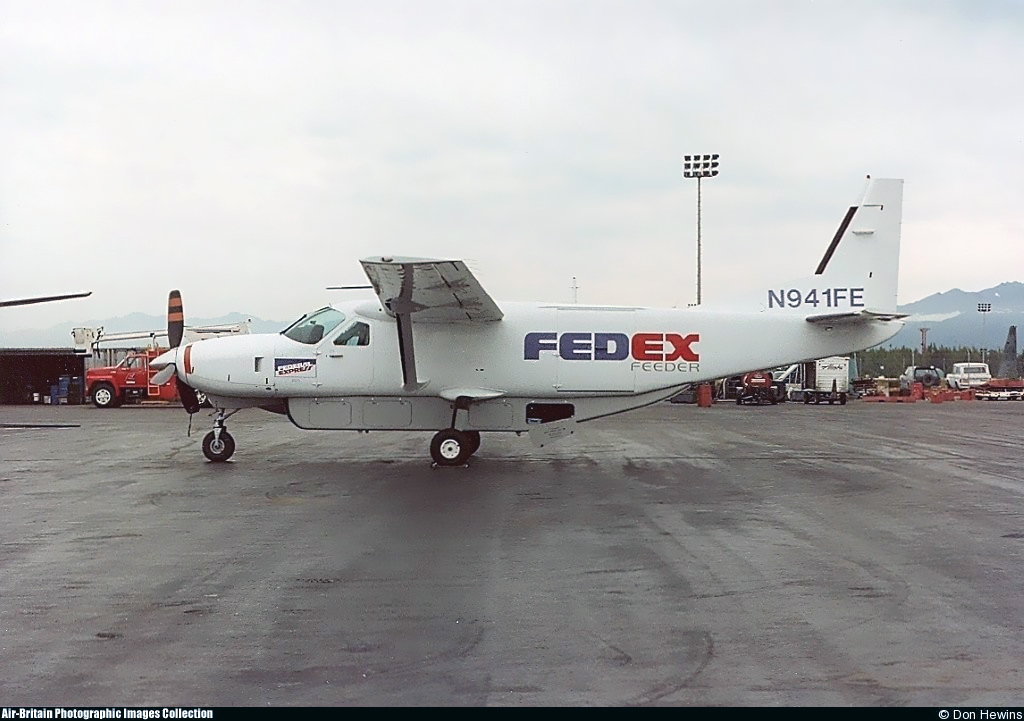
Crash of a Cessna 208B Super Cargomaster on Lummi Island: 1 killed
Date & Time:
Oct 9, 2000 at 0951 LT
Operator:
Registration:
N941FE
Survivors:
No
Schedule:
Bellingham – Eastsound
MSN:
208B-0192
YOM:
1989
Flight number:
FDX665
Crew on board:
1
Crew fatalities:
Pax on board:
0
Pax fatalities:
Other fatalities:
Total fatalities:
1
Captain / Total hours on type:
4500.00
Aircraft flight hours:
3526
Circumstances:
With a reported ceiling of 500 feet and visibility of 2 miles, the pilot requested and received a Special Visual Flight Rules (VFR) clearance to depart the Bellingham airport. He then took off and called clear of Bellingham's Class D airspace. A witness reported seeing the aircraft flying very low over water near the accident site, appearing to go in and out of clouds, and subsequently seeing it turn toward rising wooded terrain and disappear into the clouds. The aircraft crashed shortly thereafter. Witnesses reported very low ceilings and fog in the accident area at the time. Pieces of the aircraft's left wing and left horizontal stabilizer, along with a felled treetop, were found between the location of the witness's sighting and the main crash site, on or near the crest of a hill about 1/4 mile from the main crash site. These pieces exhibited leading-edge and primary structure damage, and leading-edge-embedded plant material, consistent with the pieces separating from the aircraft upon contact with trees. Wreckage and impact signatures at the main crash site were indicative of an uncontrolled impact with the ground. Investigators found no evidence of any aircraft malfunctions or cargo anomalies occurring prior to the apparent tree strikes.
Probable cause:
The pilot's attempted flight into known adverse weather conditions, and his subsequent failure to maintain altitude above, or clearance with, trees. Factors contributing to the accident included low ceilings, fog, the pilot's low-altitude flight, rising terrain, and trees.
Final Report: