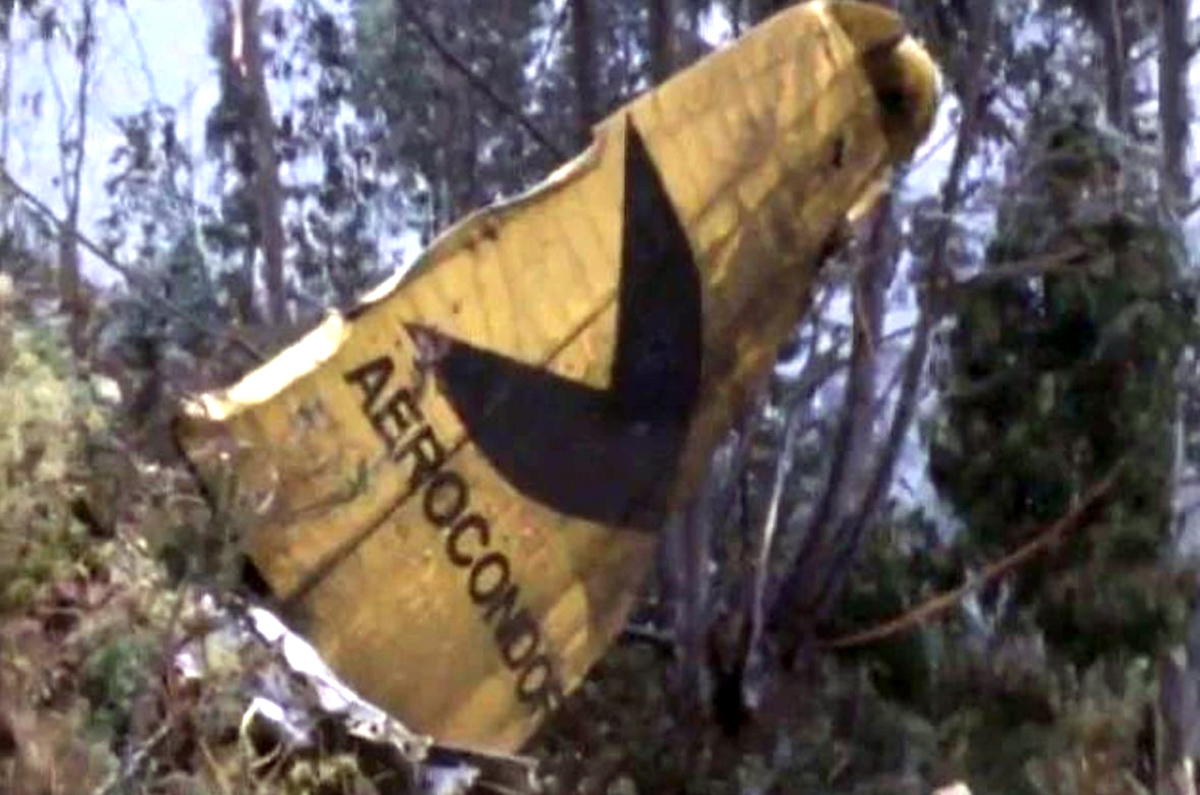
Crash of a Lockheed L-188A Electra on Mt El Cable: 42 killed
Date & Time:
Aug 27, 1973 at 0746 LT
Operator:

Registration:
HK-777
Survivors:
No
Schedule:
Bogotá – Cartagena – Barranquilla – San Andres – Willemstad
MSN:
1115
YOM:
1959
Flight number:
OD130
Crew on board:
6
Crew fatalities:
Pax on board:
36
Pax fatalities:
Other fatalities:
Total fatalities:
42
Captain / Total hours on type:
601.00
Copilot / Total hours on type:
134
Aircraft flight hours:
28914
Circumstances:
The four engine airplane departed Bogotá-El Dorado Airport Runway 12 at 0743LT on a flight to Willemstad, Curaçao, with intermediate stops in Cartagena, Barranquilla and San Andres Island. There were 36 passengers and six crew members on board. One minute and 50 seconds later, ATC instructed the crew to change frequency from 118.1 to 121.3. About three minutes after takeoff, while climbing, the airplane impacted the slope of Mt El Cable located 12 km southeast of the airport. The aircraft disintegrated on impact and all 42 occupants were killed.
Probable cause:
Available evidences were insufficient to establish with certainty the probable cause or causes of the accident.
The following findings were identified:
- The poor visibility conditions prevailing in the Bogotá area, particularly in the eastern hills where the accident occurred, played a decisive role in the accident.
- The takeoff and most of the initial climb proceeded normally. During the final phase of the flight, it was observed that the aircraft did not reach the required altitude and, more importantly, did not initiate the turn toward the Techo radio beacon in a timely manner, as required by procedure. For reasons that could not be clearly determined, the aircraft continued on its flight path until a few seconds before impact, at which point the pilot initiated a right turn even though the accident was already inevitable.
- The loss of data from both CVR and FDR erased essential evidence regarding the factors that caused the accident.
- Given the captain’s high level of flying skills, his dedication to strictly fulfilling his duties, and his excellent control of the aircraft, the investigators concluded that, although there is evidence suggesting a possible error in the application of established procedures during the takeoff phase, there may also have been a factor that could not be determined during the investigation and that may well have been a cause of the accident.
The following findings were identified:
- The poor visibility conditions prevailing in the Bogotá area, particularly in the eastern hills where the accident occurred, played a decisive role in the accident.
- The takeoff and most of the initial climb proceeded normally. During the final phase of the flight, it was observed that the aircraft did not reach the required altitude and, more importantly, did not initiate the turn toward the Techo radio beacon in a timely manner, as required by procedure. For reasons that could not be clearly determined, the aircraft continued on its flight path until a few seconds before impact, at which point the pilot initiated a right turn even though the accident was already inevitable.
- The loss of data from both CVR and FDR erased essential evidence regarding the factors that caused the accident.
- Given the captain’s high level of flying skills, his dedication to strictly fulfilling his duties, and his excellent control of the aircraft, the investigators concluded that, although there is evidence suggesting a possible error in the application of established procedures during the takeoff phase, there may also have been a factor that could not be determined during the investigation and that may well have been a cause of the accident.
Final Report: