Crash of a Vickers 417 Wellington III in Appleton-le-Moors: 3 killed

Date & Time: Jul 26, 1946 at 1420 LT
Type of aircraft:
Operator:
Registration:
BJ884
Flight Phase:
Flight Type:
Survivors:
No
Site:
Schedule:
Leconfield - Leconfield
Region:
Crew on board:
1
Crew fatalities:
Pax on board:
2
Pax fatalities:
Other fatalities:
Total fatalities:
3
Circumstances:
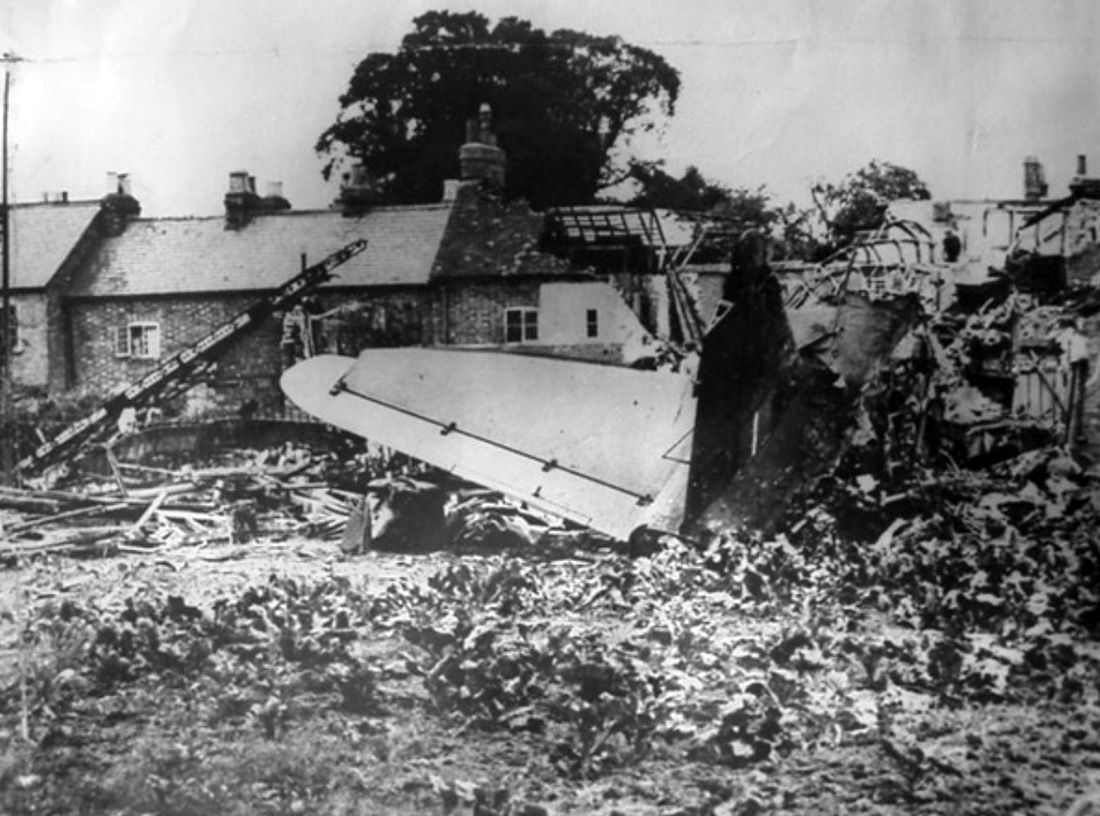
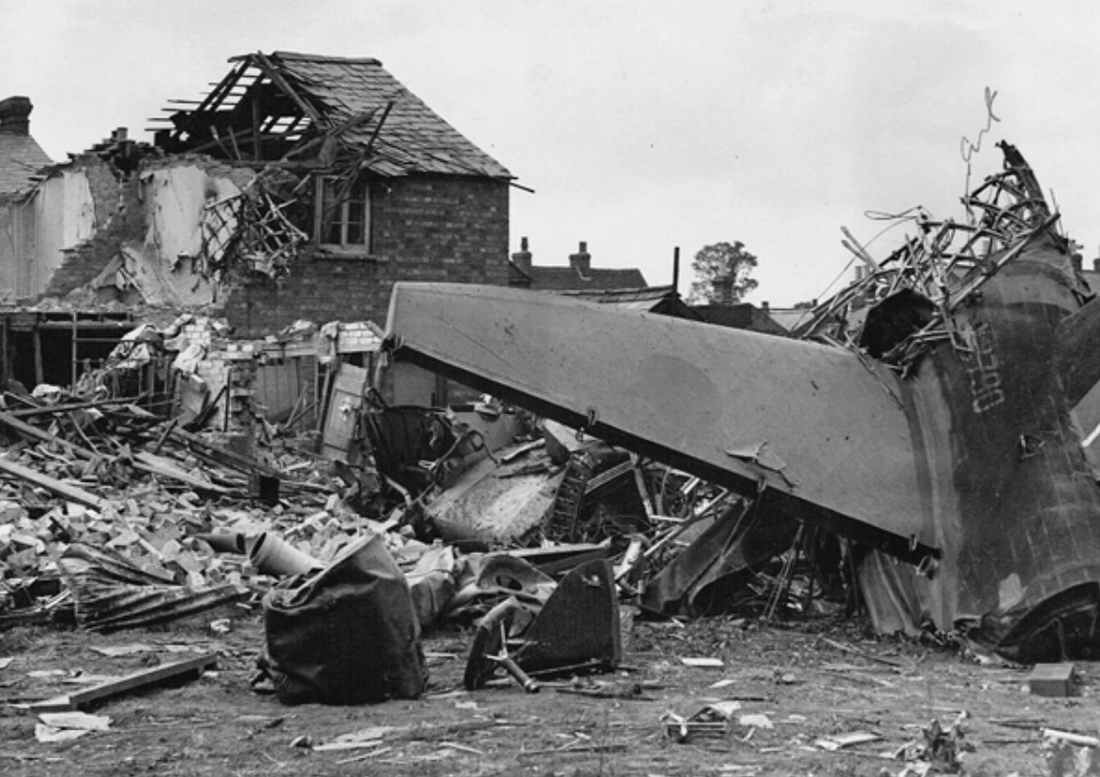
On 26th July 1946 110 (City of York) ATC Squadron were holding their annual summer camp at the Central Gunnery School (CGS) at Leconfield. As part of their camp the Cadets were being allowed to be taken as passengers on training flights the CGS were undertaking. There is a suggestion that more than one Wellington was being used for this but if this was so then the take-off times were staggered and their flights did not interrupt or engage with each other. The Wellington concerned in this incident had suffered an engine malfunction prior to take-off and the two cadets already down to have a flight on this aircraft were allocated to a different aircraft to have their trip. The faulty aircraft was soon repaired and two further cadets would be allowed to go up in this original aircraft for what become the ill-fated flight. The ill-fated flight finally took off with a pilot and two cadets on board at around 1400LT, they flew northwards and towards the North Yorkshire Moors. The pilot of the Wellington carried out a Bomber Affiliation training exercise with other aircraft, the Wellington was being subjected to a number of dummy attacks by two Spitfires. It was during one of these attacks and twenty five minutes into the flight that tragedy struck at 1420LT; one of the Spitfires was making a head-on attack on the Wellington when the pilot of the Spitfire misjudged the distance between the two aircraft. The two aircraft collided head on more or less directly over the village of Appleton-le-Moors. The Wellington partly broke up in the air, with parts being scattered across the main street in Appleton le Moors and on houses in the village. Both aircraft, including the main section of this Wellington came down in flames on and near the village football field. There would be no survivors. At the inquest to their deaths, the Coroner, Mr R K Smith gave a verdict of "death by misadventure".
Crew:
W/O Henryk Szwedowski, pilot.
Passengers:
Cadet William Anthony Lain,
Cadet Robert Hall.
Source:
http://www.yorkshire-aircraft.co.uk/aircraft/planes/46-50/bj884.html
Probable cause:
Misjudge of the distance between both aircraft on the part of the Spitfire pilot.
Crash of a Vickers 417 Wellington III in Wykeham Abbey: 5 killed

Date & Time: Jul 24, 1946 at 1645 LT
Type of aircraft:
Operator:
Registration:
BJ895
Flight Phase:
Flight Type:
Survivors:
No
Schedule:
Leconfield - Leconfield
Region:
Crew on board:
5
Crew fatalities:
Pax on board:
0
Pax fatalities:
Other fatalities:
Total fatalities:
5
Circumstances:
At 1535LT on 24th July 1946 this aircraft took off from Leconfield airfield for its crew to carry out a fighter affiliation exercise with a Spitfire (Spitfire TD236, of "F" Flight piloted by S/Ldr Leonard A Wood). The aircraft flew in a northerly direction, met up with the Spitfire over Driffield and then, owing to low cloud, the exercises were carried out at 10,000 feet over the Scarborough area. On board the Wellington was a pilot, a gunnery instructor and three trainee air gunners. During the exercise the Wellington was practicing taking evasive action when attacked by the fighter, it was thought that the pilot of the Wellington was making such a turn downwards, believed to have been the last of the exercise, but immediately after the last attack the Wellington went into a near vertical dive from between 6,000 and 7,000 feet from which it did not recover. At 1645LT the aircraft crashed into the grounds of Wykeham Abbey and while not catching fire it disintegrated on impact creating a large crater. All five on board stood no chance, they were killed instantly and the body of one of the crew was never found. The list or airmen below shows their trades as CWGC give. The resulting crash investigation reported that the aircraft had been reported as being nose-heavy in the weeks leading up to the crash but it was checked but was passed as serviceable on the day of this crash. The investigation listed a number of previous incidents when the aircraft had been inspected. It had been used in the prototype bouncing bomb trials and had its bomb doors removed for this but was later converted back to a "normal" Wellington and on 1st December 1943 repairs were completed at Vickers factory, Weybridge. On 17th July 1946 it was test flown and rear doors found locked up. A day later on 18th July 1946 it was test flown and the elevator trim for level flight was found incorrectly set, the cables were adjusted for correct movement. On 23rd July 1946 it was flown by F/Lt Meikle, who reported the aircraft nose heavy and the port engine was running slow. Extra ballast was added and the port engine revs were adjusted. On 24th July 1946 it was flown by W/O Schwedoski, who reported aircraft was satisfactory (he would be killed soon after in a crash at Appleton le Moors just a few days after this incident at Wykeham) but later that day the fatal crash at Wykeham occurred.
Crew:
W/O Roland Harrison, pilot,
F/Lt John Christopher Haldon, air gunner,
W/O Frederick Charles Stiff, air gunner,
F/Sgt Peter Ingram, air gunner,
W/O John Forest Armstrong, wireless operator and engineer.
Source:
http://www.yorkshire-aircraft.co.uk/aircraft/planes/ryedale/bj895.html
Probable cause:
The crash report concluded that the aircraft should never have been in the air on the day because of known problems with it.

Crash of a Vickers 417 Wellington III in Yorkshire: 6 killed

Date & Time: Jun 27, 1946
Type of aircraft:
Operator:
Registration:
BK214
Flight Phase:
Flight Type:
Survivors:
No
Region:
Crew on board:
6
Crew fatalities:
Pax on board:
0
Pax fatalities:
Other fatalities:
Total fatalities:
6
Circumstances:
While performing a training mission with several others aircraft, the Wellington collided with a RAF Spitfire, dove into the ground and crashed in a prairie. All six crew members were killed. The fate of the Spitfire and its pilot remains unknown.

Crash of a Vickers 417 Wellington III in Whernside: 6 killed

Date & Time: Apr 21, 1944
Type of aircraft:
Operator:
Registration:
BK347
Flight Phase:
Flight Type:
Survivors:
Yes
Region:
Crew on board:
7
Crew fatalities:
Pax on board:
0
Pax fatalities:
Other fatalities:
Total fatalities:
6
Circumstances:
The crew was engaged in a training exercise on behalf of the 30th OTU. En route, the aircraft crashed in unknown circumstances in Whernside, near Ingleton. A young sergeant was seriously injured while all six other occupants were killed.
Crew:
F/O Ernest Malcolm Barrett, pilot, †
F/L Edward Alderson, copilot, †
Sgt Philip Edwin Lomas, navigator, †
F/O Robert Gerald Campbell Brodie, bombardier, †
Sgt Ronald Charles Holmwood, wireless operator, †
Sgt Norman Skirrow, wireless operator, air gunner, †
Sgt Joseph Marks, wireless operator, air gunner.

Crash of a Vickers 417 Wellington III in Smerrill Farm: 6 killed

Date & Time: Jan 21, 1944
Type of aircraft:
Operator:
Registration:
BJ652
Flight Phase:
Flight Type:
Survivors:
No
Region:
Crew on board:
6
Crew fatalities:
Pax on board:
0
Pax fatalities:
Other fatalities:
Total fatalities:
6
Circumstances:
Crew was performing a night training flight for the 27th OTU. En route, the aircraft went out of control and crashed in a field located in Smerrill Farm, Gloucestershire. All six crew members were killed.

Crash of a Vickers 417 Wellington III in Winslow: 17 killed

Date & Time: Aug 7, 1943 at 0255 LT
Type of aircraft:
Operator:
Registration:
X3790
Flight Type:
Survivors:
Yes
Site:
Schedule:
Little Horwood - Little Horwood
Region:
Crew on board:
5
Crew fatalities:
Pax on board:
0
Pax fatalities:
Other fatalities:
Total fatalities:
17
Circumstances:
The crew left RAF Little Horwood on a night training bombing exercise. As the bomb sight was defective, the exercise was aborted and the captain decided to return to RAF Little Horwood. During the final approach completed by night, the aircraft crashed on several houses located in the village of Winslow, less than one mile short of runway. Four crew members were killed as well as 13 people in the houses, among them 5 children. The radio navigator, aged 19, was the only survivor.
Crew (26th OTU):
Sgt Wilfred Davies, pilot, †
Sgt Jeffrey Harrington, radio navigator,
Sgt Valentine Jack McKeon, wireless operator and air gunner, †
Sgt John Sowter, bomb aimer, †
F/Sgt Clive Fietz. †
Civilians killed:
Thomas Cox,
Tom Paintin and his son Donald,
William and Nora Hawkins,
Stephen and Doris Mullis and their children Terence and Kathleen,
Israel and Annie Goldberg, their daughter Lottie Hoberman and her son Victor.
Source: http://www.winslow-history.org.uk/twentiethc-aircrash.shtm

Crash of Vickers 417 Wellington III near Paris: 2 killed

Date & Time: Jun 12, 1943
Type of aircraft:
Operator:
Registration:
BK559
Flight Phase:
Flight Type:
Survivors:
Yes
Schedule:
Hixon - Hixon
Location:
Country:
Region:
Crew on board:
6
Crew fatalities:
Pax on board:
0
Pax fatalities:
Other fatalities:
Total fatalities:
2
Circumstances:
The airplane departed RAF Hixon at 2300LT on June 11 on an operation to Nantes (Nickel Operation). The crew became hopelessly lost and, from an altitude of 8,000 feet, abandoned the airplane that was low on fuel. The airplane crashed near Paris and was destroyed. Two crew were killed, one evaded and three became PoW.
Crew:
F/Sgt Thomas George Dellar, pilot, †
F/Sgt Delmar Murray Davis, navigator, †
F/Sgt Cyril Edward Bartholomew,
Sgt James Graham Perfect,
Sgt B. C. Reeves,
Sgt Horace John David Adams, air gunner.
Probable cause:
Fuel exhaustion.

Crash of a Vickers 417 Wellington III into The Channel: 5 killed

Date & Time: May 24, 1943
Type of aircraft:
Operator:
Registration:
BK489
Flight Phase:
Flight Type:
Survivors:
No
Schedule:
Lichfield - Lichfield
Country:
Region:
Crew on board:
5
Crew fatalities:
Pax on board:
0
Pax fatalities:
Other fatalities:
Total fatalities:
5
Circumstances:
The airplane departed RAF Lichfield on a Operation Nickel to Paris. It failed to return to base and is believed to have crashed somewhere into The Channel. Lost without trace.
Crew:
Sgt Charles Wilson Astle, pilot,
Sgt Charles Arthur Warnes,
Sgt Charles Frederick Wells,
Sgt William Antcliffe,
Sgt Allen Drury, air gunner.

Crash of a Vickers 417 Wellington III near RAF Finningley: 5 killed

Date & Time: May 12, 1943 at 1530 LT
Type of aircraft:
Operator:
Registration:
BK353
Flight Phase:
Flight Type:
Survivors:
No
Schedule:
Finningley - Finningley
Region:
Crew on board:
5
Crew fatalities:
Pax on board:
0
Pax fatalities:
Other fatalities:
Total fatalities:
5
Circumstances:
The airplane departed RAF Finningley at 1425LT on a local single engine training exercise. While cruising at an altitude of 2,000 feet with one engine out, the pilot lost control of the airplane that crashed near the airbase. All five crew members were killed.
Crew:
Cpt Edward Pawel Zakrzewski,
Cpt Tadeusz Michal Opulski,
Cpl Roman Drapala,
Cpl Mieczysław J. Frankiewicz,
Cpl Tadeusz Pasternak.

Crash of a Vickers 417 Wellington III in Scottlethorpe: 3 killed

Date & Time: May 12, 1943 at 1240 LT
Type of aircraft:
Operator:
Registration:
BK123
Flight Phase:
Flight Type:
Survivors:
No
Schedule:
North Luffenham - North Luffenham
Region:
Crew on board:
3
Crew fatalities:
Pax on board:
0
Pax fatalities:
Other fatalities:
Total fatalities:
3
Circumstances:
The airplane departed RAF North Luffenham at 1215LT on a local training exercise. En route, the crew was unable to locate the airfield and attempted a single engine emergency landing when the airplane crashed in an open field located in Scottlethorpe, 4 km northwest of Bourne. All three crew members were killed.
Crew:
Sgt Frederick Thomas Allen, pilot,
Sgt John Angus Douglas,
Sgt John Sidney Harris, wireless operator.
Probable cause:
Engine failure.