Country
Crash of an Embraer ERJ-145LU in Vitoria da Conquista
Date & Time:
Aug 25, 2010 at 1440 LT
Operator:

Registration:
PR-PSJ
Survivors:
Yes
Schedule:
São Paulo – Vitoria da Conquista
MSN:
145-351
YOM:
2000
Flight number:
PTB2231
Crew on board:
3
Crew fatalities:
Pax on board:
35
Pax fatalities:
Other fatalities:
Total fatalities:
0
Captain / Total hours on type:
3100.00
Copilot / Total hours on type:
813
Circumstances:
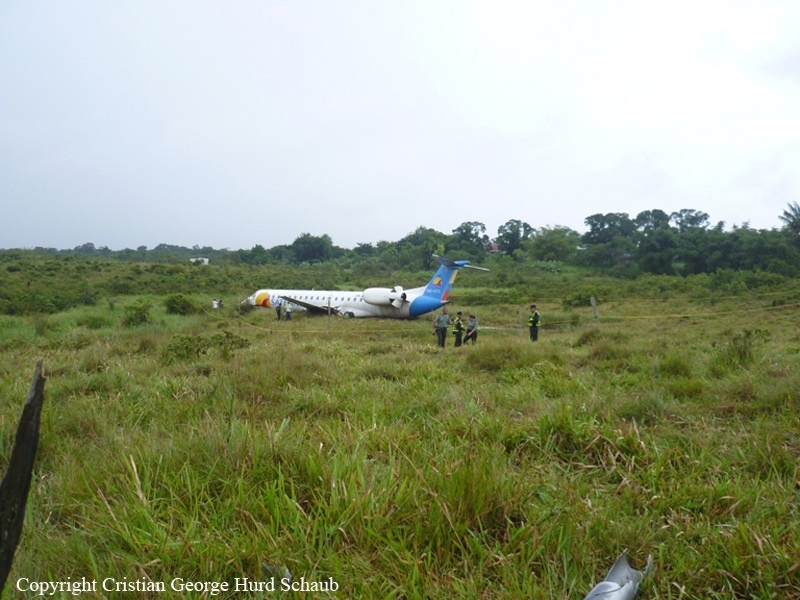
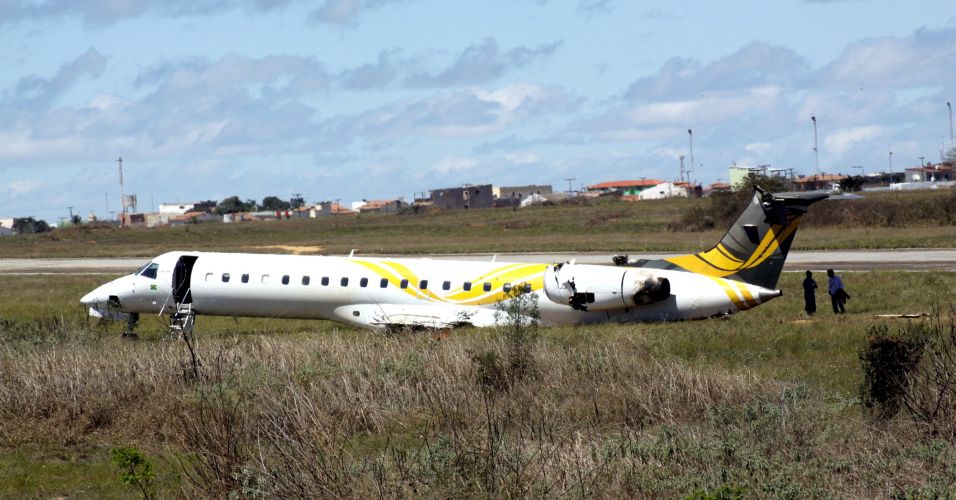
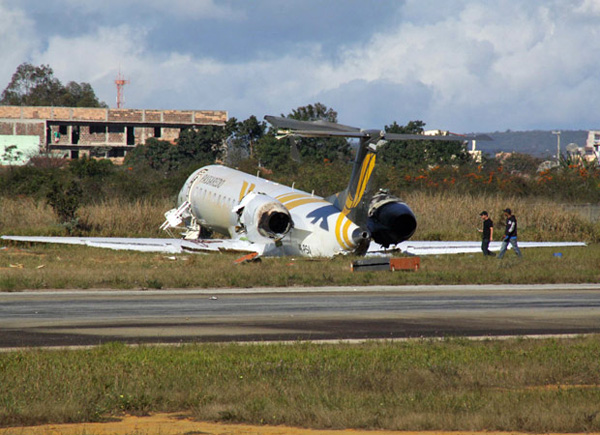
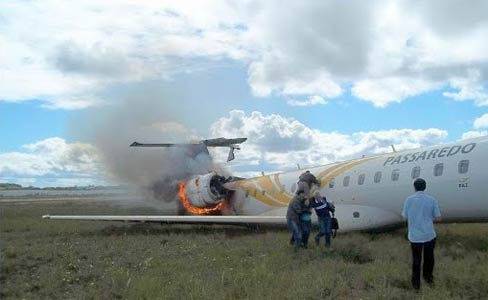
While approaching Vitoria da Conquista Airport runway 15, the crew failed to realize his altitude was too low. On short final, the aircraft impacted a small mound located few metres short of runway threshold. On impact, both main landing gears were torn off. The aircraft slid on runway for about 300 metres then veered off runway to the left and came to rest in a grassy area some 35 metres left of the runway with the right engine on fire. All 38 occupants escaped uninjured while the aircraft was damaged beyond repair.
Probable cause:
The following factors were identified:
- During the approach, the flight crew's attention was focused on the characteristics of the geographical relief and presence of birds, reducing their awareness as to the maintenance of the approach slope.
- The group culture of maintaining a low angle of approach led the crew to choose the runway aspect instead of the VASIS as a reference for the approach, making them susceptible to various types of spatial illusion.
- Taking into account copilot's report that he was not succeeding in correcting the aircraft glide path relative to the runway, one may suppose that he was not applying the appropriate amplitude for such correction.
- The physical characteristics of the runway 15 (the active one) contributed to a wrong perception of the ideal glide path. The pronounced acclivity of the runway, its width (narrower than the runways on which the crew was accustomed to operate), and the low terrain near the threshold, caused in the pilots a perception that they were above the ideal approach slope, leading them to seek correction, which resulted in an angle of approach below the ideal one.
- For the flight in question, the company chose two pilots who had never operated in SBQV. A crewmember with previous experience in the locality would have a higher level of awareness in relation to the specific characteristics of the aerodrome.
- No company publications were found that could provide the pilots with guidance on the specifics of SBQV, capable of helping with the management of the risks associated with the operation in that aerodrome.
- During the approach, the flight crew's attention was focused on the characteristics of the geographical relief and presence of birds, reducing their awareness as to the maintenance of the approach slope.
- The group culture of maintaining a low angle of approach led the crew to choose the runway aspect instead of the VASIS as a reference for the approach, making them susceptible to various types of spatial illusion.
- Taking into account copilot's report that he was not succeeding in correcting the aircraft glide path relative to the runway, one may suppose that he was not applying the appropriate amplitude for such correction.
- The physical characteristics of the runway 15 (the active one) contributed to a wrong perception of the ideal glide path. The pronounced acclivity of the runway, its width (narrower than the runways on which the crew was accustomed to operate), and the low terrain near the threshold, caused in the pilots a perception that they were above the ideal approach slope, leading them to seek correction, which resulted in an angle of approach below the ideal one.
- For the flight in question, the company chose two pilots who had never operated in SBQV. A crewmember with previous experience in the locality would have a higher level of awareness in relation to the specific characteristics of the aerodrome.
- No company publications were found that could provide the pilots with guidance on the specifics of SBQV, capable of helping with the management of the risks associated with the operation in that aerodrome.
Final Report:

Crash of an Embraer ERJ-145LR in Mitú
Date & Time:
May 5, 2010 at 1049 LT
Operator:

Registration:
FAC-1173
Survivors:
Yes
Schedule:
Villavicencio - Mitú
MSN:
145-879
YOM:
2005
Flight number:
NSE9634
Crew on board:
5
Crew fatalities:
Pax on board:
37
Pax fatalities:
Other fatalities:
Total fatalities:
0
Captain / Total hours on type:
1060.00
Copilot / Total hours on type:
806
Aircraft flight hours:
9095
Circumstances:
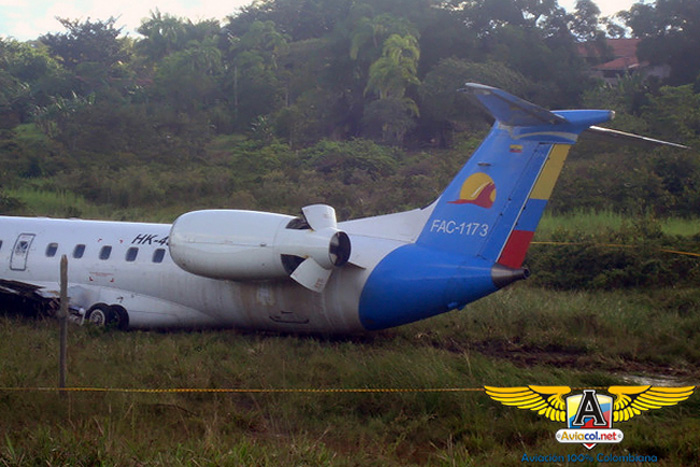
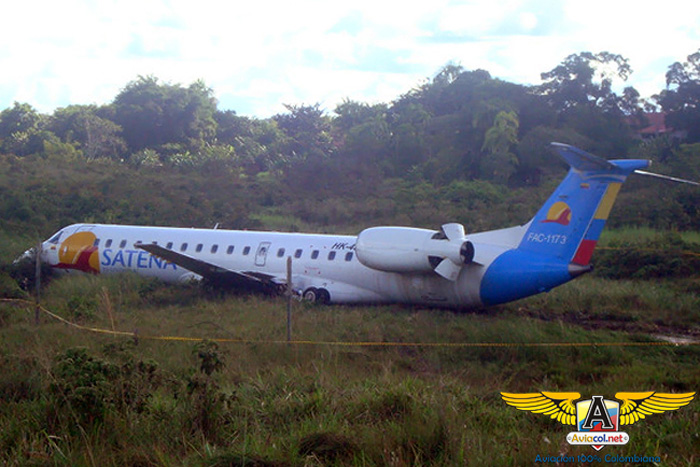
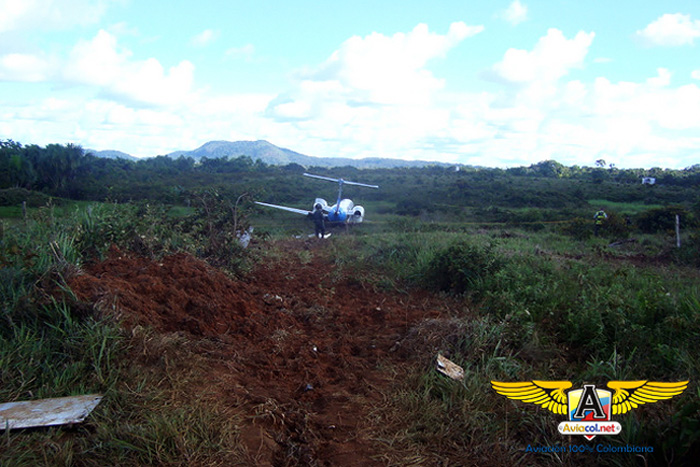
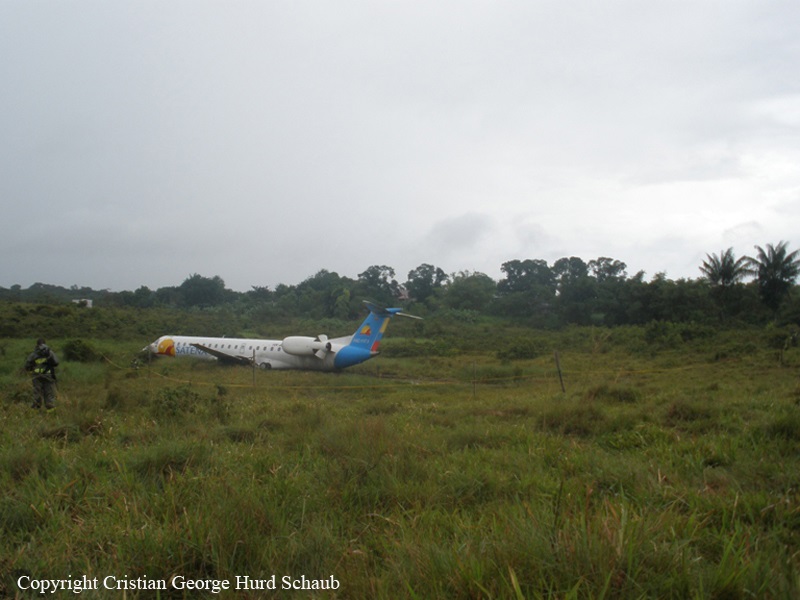
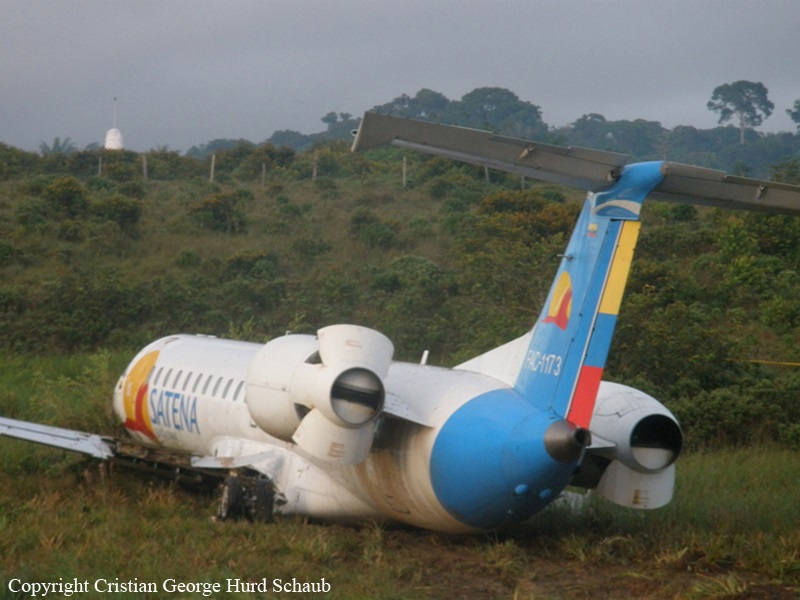
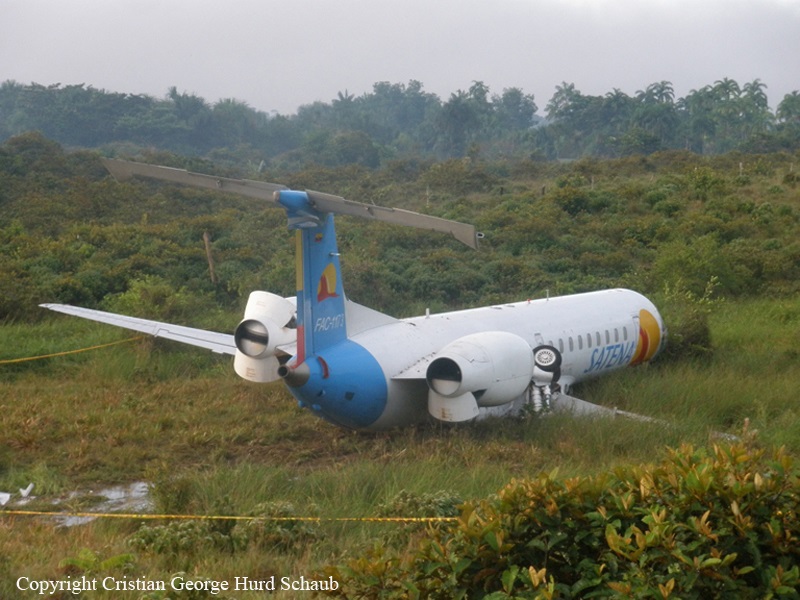
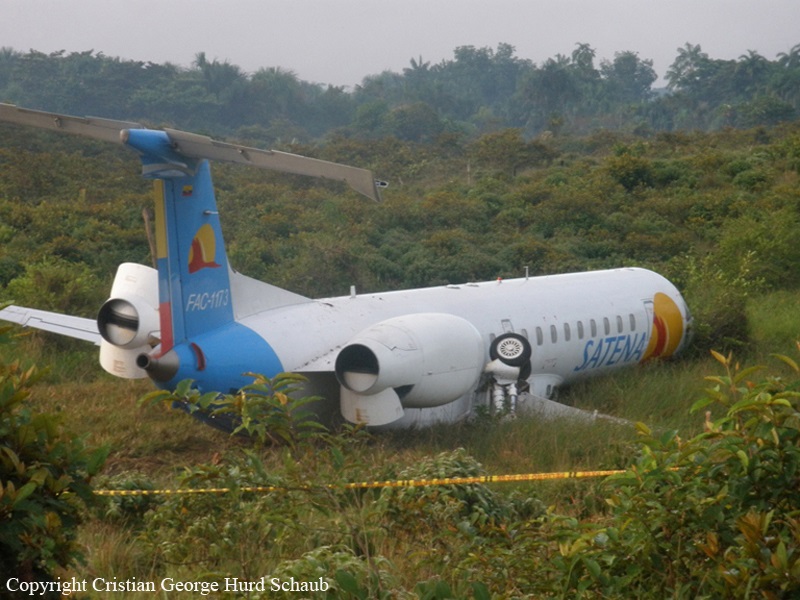
After landing on runway 20 (1,760 meters long) at Mitú-Fabio Alberto León Bentley Airport, the aircraft encountered difficulties and was unable to stop within the remaining distance. It overran at a speed of 52 knots, went through a fence, lost its undercarriage and came to rest in a prairie some 163 metres further. All 41 occupants were uninjured while the aircraft was damaged beyond repair. It was registered FAC-1173 (military) and HK-4536 (civil).
Probable cause:
Wrong approach configuration on part of the crew. Execution of the landing procedure on runway 20 despite the fact that aircraft was unstable on approach. At runway threshold, the aircraft altitude was too high and its speed upon touchdown was excessive (132 knots). The airplane touched down 562 metres past the runway threshold, well beyond the touchdown zone. All brakes systems were activated but the upper right thrust reverser deployed and retracted shortly later due to technical reasons, which was considered as a contributory factor. The following factors also contributed to the mishap:
- Poor techniques used by the pilot-in-command on approach and after touchdown,
- Deviation from standard operating procedures (SOP),
- Non-adherence to published procedures,
- No reaction or corrective action to the EGPWS alarm.
- Poor techniques used by the pilot-in-command on approach and after touchdown,
- Deviation from standard operating procedures (SOP),
- Non-adherence to published procedures,
- No reaction or corrective action to the EGPWS alarm.
Final Report: