


Date & Time:
May 1, 1979 at 1805 LT
Type of aircraft:
Beechcraft 90 King Air
Operator:

Registration:
C-FCAS
Flight Phase:
Flight
Flight Type:
Calibration
Survivors:
No
Site:
Plain, Valley
Schedule:
Montreal - Montreal
MSN:
LJ-23
YOM:
1965
Country:
Canada
Region:
North America
Crew on board:
2
Crew fatalities:
2
Pax on board:
0
Pax fatalities:
0
Other fatalities:
0
Total fatalities:
2
Aircraft flight hours:
5466
Circumstances:
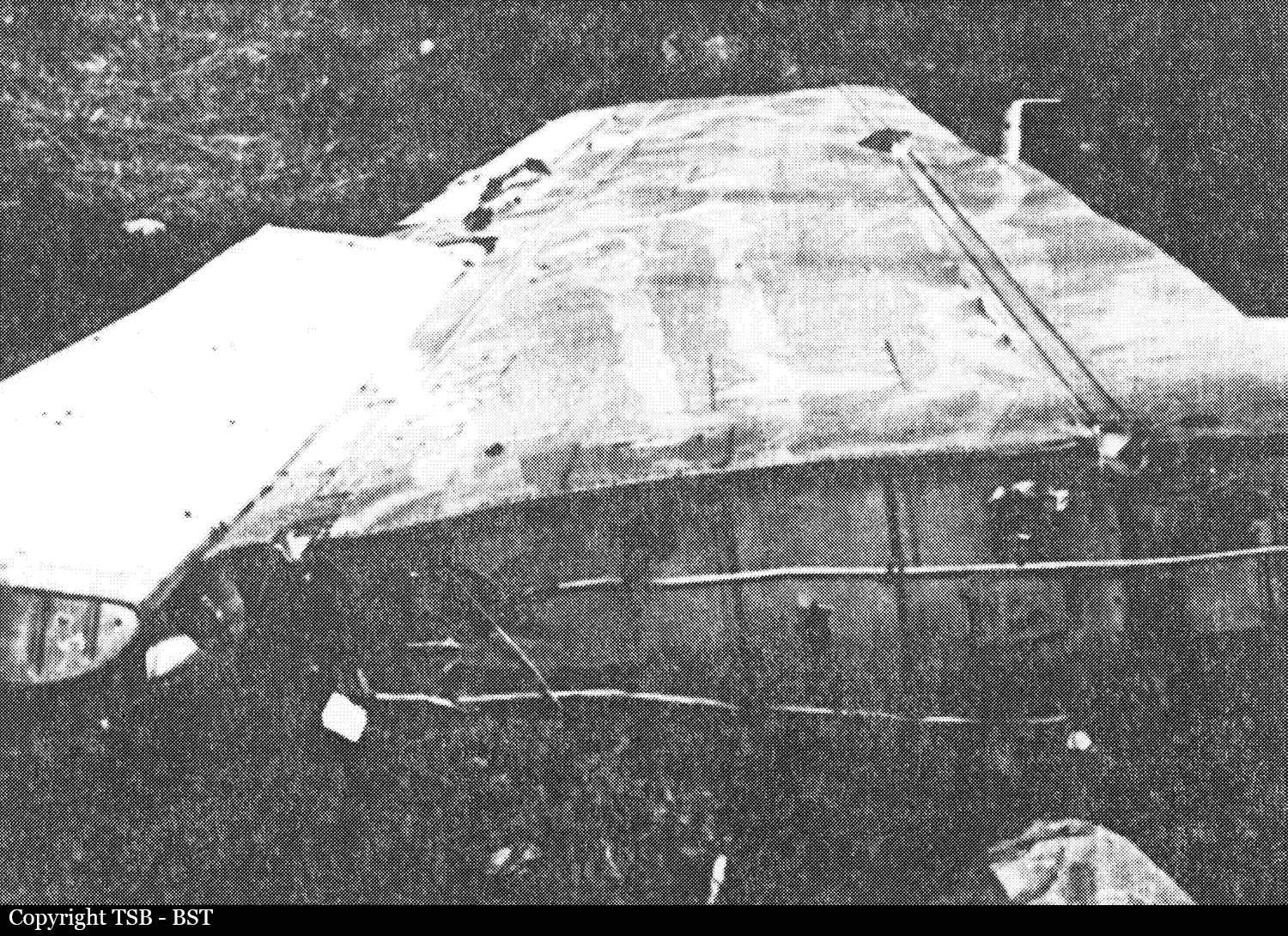
The crew was engaged in a calibration flight on behalf of Transport Canada. The twin engine airplane departed Montreal-Dorval Airport at 1741LT to proceed with the calibration of a radar antenna. After contact was established with ATC, the crew initiated an orbit 20 NM from the antenna at an altitude of 1,700 feet. After crossing the 165 radial, the airplane entered an uncontrolled descent and crashed in a field located near Sherrington. The airplane was totally destroyed and both occupants were killed. It was determined that the outside section of the right wing, after the right engine nacelle, separated in flight and was found 640 metres from the main wreckage.
Probable cause:
The following findings were identified:
- The right hand lower forward outboard wing attachment fitting of C-FCAS had developed a progressive crack of sufficient magnitude to cause in-flight fracture, and consequent immediate wing separation outboard of the right hand engine nacelle, under normal flight loads.
- The laboratory analysis revealed the Progressive cracking was complex and of mixed modes in the initiation and early growth stages. The latter stages appeared to be essentially all due to fatigue cracking, driven by cyclic stresses generated in flight. The failed fitting exhibited a manufacturing deficiency in the form of gas bubbles located on the grain boundaries. Much of the early cracking appeared to be strongly influenced by the presence of these bubbles.
- It was not possible to precisely evaluate the mode or rate of crack propagation since insufficient basic data exists to determine the adverse influence of the gas bubbles on the performance of such flawed material.
- The fitting met all relevant specifications. It is not considered any typical quality control procedure would have detected the gas bubble deficiency. The available evidence suggests that only some fittings in a relatively small production batch of P/N 50-110057 fittings are defective in this manner, and that cracking similar to that in C-FCAS only occurs in this batch of fittings.
- The evidence indicates that the fitting was inspected in accordance with Airworthiness Directive 70-25-04 and Service Instruction 0394-018 at 4,907 hours, and that no crack was detected at that time.
- Since the accident the FAA and the manufacturer have affirmed that the dye penetrant inspection should have been made at 5,407 hours on the basis of a 500 hour inspection interval. This inspection was not made - if it had been made it is most probable that a crack would have been detected.
- There is a lack of clarity in AD 70-25-04 that resulted in the DOT and other maintenance personnel interpreting the AD as meaning that a 500 hour aye penetrant inspection was not mandatory if wing skin cracks were not found at the regular 100 hour skin inspections, which were carried out.
- The right hand lower forward outboard wing attachment fitting of C-FCAS had developed a progressive crack of sufficient magnitude to cause in-flight fracture, and consequent immediate wing separation outboard of the right hand engine nacelle, under normal flight loads.
- The laboratory analysis revealed the Progressive cracking was complex and of mixed modes in the initiation and early growth stages. The latter stages appeared to be essentially all due to fatigue cracking, driven by cyclic stresses generated in flight. The failed fitting exhibited a manufacturing deficiency in the form of gas bubbles located on the grain boundaries. Much of the early cracking appeared to be strongly influenced by the presence of these bubbles.
- It was not possible to precisely evaluate the mode or rate of crack propagation since insufficient basic data exists to determine the adverse influence of the gas bubbles on the performance of such flawed material.
- The fitting met all relevant specifications. It is not considered any typical quality control procedure would have detected the gas bubble deficiency. The available evidence suggests that only some fittings in a relatively small production batch of P/N 50-110057 fittings are defective in this manner, and that cracking similar to that in C-FCAS only occurs in this batch of fittings.
- The evidence indicates that the fitting was inspected in accordance with Airworthiness Directive 70-25-04 and Service Instruction 0394-018 at 4,907 hours, and that no crack was detected at that time.
- Since the accident the FAA and the manufacturer have affirmed that the dye penetrant inspection should have been made at 5,407 hours on the basis of a 500 hour inspection interval. This inspection was not made - if it had been made it is most probable that a crack would have been detected.
- There is a lack of clarity in AD 70-25-04 that resulted in the DOT and other maintenance personnel interpreting the AD as meaning that a 500 hour aye penetrant inspection was not mandatory if wing skin cracks were not found at the regular 100 hour skin inspections, which were carried out.
Final Report:
C-FCAS.pdf2.18 MB

